Things have really picked up here over the holidays, including our first woodpeckers!
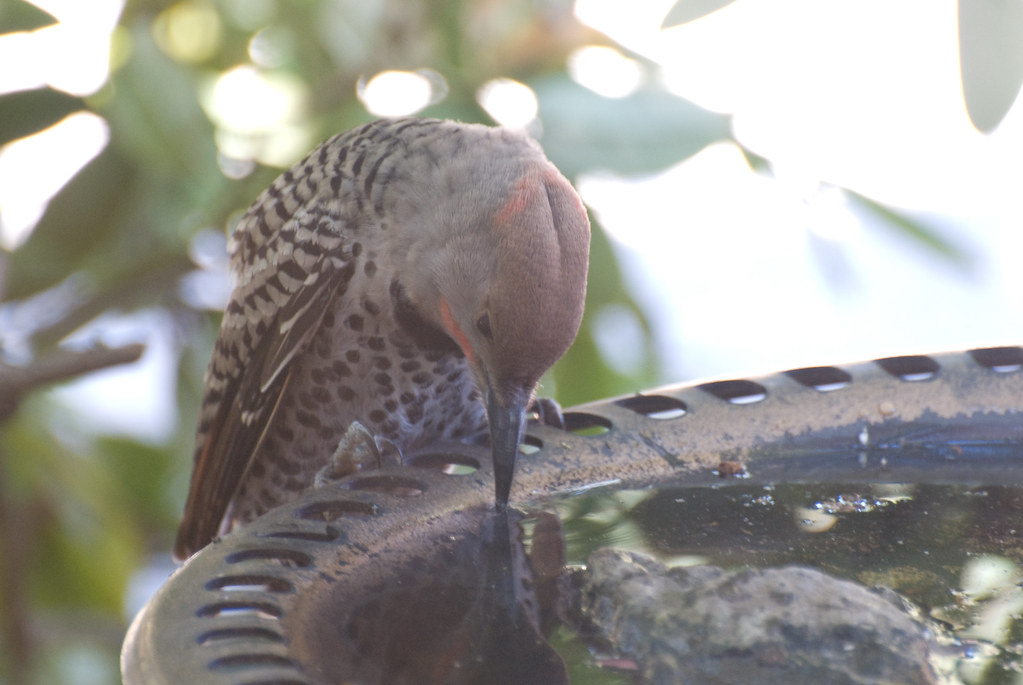
 After over a month and a half of no woodpeckers (not even a Downy!), we were rewarded with TWO Northern Flickers last weekend. This was somewhat surprising, as Downies are more prevalent than Flickers in urban/suburban areas with minimal mature trees. Even more surprising is that one of them was a Red- x Yellow-shafted "Intergrade" (a hybrid of the two subspecies). There are not exactly unheard of out here, but it was a nice surprise. I hosted a similar-looking intergrade juvenile at our previous residence (2 miles away) this summer and am wondering if this is the same bird.

A Northern Flicker stops in for some suet. This individual appears to be a regular now.
 An "Intergrade" Northern Flicker. Note the small red mark on the nape. This individual very well may be the same one that we saw at our previous residence this summer.But Flickers aren't the only story here. A pair of Mourning Doves graced us with their presence a week and a half ago. Some of you Easterners may wonder why I consider this noteworthy, but these were actually the first two first yard Mourning Doves that I've hosted here. They're far from uncommon, but their numbers are far lower here than in the other half of the country. I'm actually somewhat surprised that they haven't returned.
This past weekend was extremely active, owing to a massive amount of flocking. There was a mixed flock of 300+ Starlings and Robins in the neighborhood and, at one time, approximately 200 Starlings in the backyard. Fortunately, that only lasted for a day, and the Starlings appear to have completely moved on (knock on wood). However, it was nice to listen to the calls of Robins for a few days. An added bonus was a small flock of Cedar Waxwings last Saturday. They did little more than perch and occasionally feed in the neighbor's apple tree, but they were a treat nonetheless.
 FeederWatch Data for Fall/Winter 2009. Overall, things are looking up.
 Starlings invade the suet feeder! Thankfully, only for a few days.
 A flock of Waxwings help ease the Starling surge...
 ...and Robins are always a good time.
 "CooOOoo-woo-woo-woooo"
Our "usual suspects" are still out in full force. These include our numerous Juncos and Bushtits, American Goldfinches, House Finches, White- and Golden-crowned Sparrows, noisy Scrub-Jays, our ultra-aggressive Yellow-rumped Warbler, and the elusive-but-regular Ruby-crowned Kinglet. The only downer thus far was the discovery of a House Finch with Avian Pox this morning. Hopefully that doesn't spread.
 Our not-so-friendly Yellow-rumped Warbler is happy to have the feeder all to itself.
 If you have peanuts, you'll have Scrub-Jays.
 Our resident White-crowned Sparrow feeds on millet and cracked corn.
 Actual visual evidence of our elusive Ruby-crowned Kinglet!
I had the opportunity to get out of the yard recently and photo a couple of passerines. The rain and fog hampered my efforts somewhat, but I was able to get really nice photos of a Ruby-crowned Kinglet and a Brown Creeper...

 Well, that's about it for now. I hope that you had a good holiday and here's to a wonderful 2010!
I thought I'd take a break from the usual (and sometimes repetitive and boring) yard photos and share some of the photos that I've taken around the state over the past two years. After assembling these photos, two things became apparent to me: (1) I don't get out nearly enough and (2) I really need a 500 mm lens (donations gladly accepted!). Some of these photos turned out well and others... meh, not so well. But for better or worse, here they are...
 Brandt's Cormorants, Lane County Coast
 Wood Duck, Drake Park, Bend
 Bufflehead, Waldo Lake, Lane County
 Cooper's Hawk, Mt. Hood
 California Quail, Mt. Hood
 Killdeer, Secret House Winery, Veneta
 Spotted Sandpiper (juvenile), Waldo Lake, Lane County
 Dunlin, Lane County Coast
 Rufous Hummingbird, Secret House Winery, Veneta
 White-headed Woodpecker, Cold Springs Campground, Deschutes County
 Western Wood-Pewee, Cold Springs Campground, Deschutes County
 Cassin's Vireo, Cold Springs Campground, Deschutes County
 Clark's Nutcracker, Crater Lake National Park
 Common Raven, McKenzie Pass, Linn County
 Tree Swallow, Secret House Winery, Veneta
 Mountain Chickadee, Cold Springs Campground, Deschutes County
 Chestnut-backed Chickadee (fledgling), Lane County Coast
 White-breasted Nuthatch, Cold Springs Campground, Deschutes County
 Marsh Wren, Fern Ridge Reservoir, Lane County
 Mountain Bluebird, Waldo Lake, Lane County
 Yellow-rumped Warbler, Cold Springs Campground, Deschutes County
 Townsend's Warbler, Cold Springs Campground, Deschutes County
 Wilson's Warbler, Cold Springs Campground, Deschutes County
 Western Tanager, Cold Springs Campground, Deschutes County
 Green-tailed Towhee, Cold Springs Campground, Deschutes County
 Spotted Towhee, Mt. Pisgah, Springfield
 Chipping Sparrow, Cold Springs Campground, Deschutes County
 Fox Sparrow, Cold Springs Campground, Deschutes County
 Song Sparrow, Mt. Pisgah, Springfield
 Golden-crowned Sparrow, Mt. Hood
 Black-headed Grosbeak, Calliope Crossing, near Sisters
 Red Crossbill, McKenzie Pass, Linn County
 Evening Grosbeak, Secret House Winery, Veneta
The few of you who follow this blog may remember last December's winter storm that dumped several inches of snow and sent temperatures into the teens. We haven't received any snow yet, but we had a heck of a cold snap this week. Lows in the teens and even single digits trumped last December's cold snap and made life miserable for our hummingbirds again.

 Temperatures began to drop into the mid-20s last Saturday and Sunday evening. Then an Arctic high pressure system hit on Monday and drove temperatures down further, with temperatures remaining above freezing throughout much of the week. While the cold was a minor annoyance to species such as the American Goldfinches pictured on the left, this weather presented a much more problematic scenario for our Anna's Hummingbirds. Not only do hummers in general expend a ridiculous amount of energy by beating their wings 80 times per second, their natural winter food sources (small insects such as ticks and mites) tend to not hang around on the surfaces of plants in this weather. Thus, hummers are even more reliant on sugar-water feeders in these conditions - to the point where they're almost completely dependent on them. While sugar-water feeders typically stay thawed down to about 27 degrees, that's not much help when it's 12 degrees at dawn. To help combat this, I've wrapped the feeder in bubble wrap, stored it in my bathtub overnight, taken it out at twilight (7 am), taken it back inside to warm with a hair dryer at 8:30, and have let the sun do its job while I'm at work. Even if the feeder froze in the late morning before re-thawing, the hummers still had the ability to energize in the morning and late in the afternoon. And thankfully, both of our resident Anna's managed to survive. (Temperatures are back to normal this evening.)
 An Anna's Hummingbird energizes on a very cold morning.
 An "Audubon's" Yellow-rumped Warbler prepares to dine on suet.
 A flock of Bushtits crowd the caged suet feeder on a chilly morning.
The cold has brought out a few more of the "usual suspects." This includes an uptick in House Finches (up to 7 at a time now), Bushtits (flocks of 20+), Scrub-Jays (3 at a time), Juncos (8-10 at a time) and, unfortunately, Starlings as well (thankfully only 4 at a time). Interestingly, American Goldfinches have been on the decline since we first moved in. Not sure what that's all about, but they're notoriously nomadic so it's not exactly a shocker.
 The one exciting "new" yard bird observed recently is the White-crowned Sparrow (above). First observed last Saturday, this one has visited the yard to feed on millet and cracked corn just about every day since. Interestingly (but not surprisingly), the closely-related White-throated Sparrow observed last month appears to be long gone. Thankfully, our two Golden-crowned Sparrows are still daily visitors.
 A Western Scrub-Jay prepared to go in for some peanuts.
 One of our two Golden-crowned Sparrows perches atop our neighbor's fence.
Well, it's been a full month now and still no woodpeckers (not even a Downy!). Hopefully that changes soon. And, who knows, maybe some Pine Siskins will show up as well. Until next time...