Migrants have finally made their way into town, and brought some beautiful (albeit brief) weather along with them. This typically-exciting time of the year has not disappointed.
 Rufous Hummingbirds (above) typically arrive on the Oregon coast in late February, reaching the Valley in early March. Males typically arrive first, followed closely by females. We've seen them in the yard as early as the first week of March, but this is highly variable. Our first yard Rufous was spotted on the 19th, and both sexes have been visiting both the nectar feeder and the flowering bushes regularly since. Anna's Hummingbirds are still around occasionally visit the nectar feeder, but are busy nesting for the most part. In general, March-May is a great time period for Rufous Hummers and I hope to procure several more photos over the next two months.
 While certain species are expected during migration, it often brings pleasant surprises as well. And this Spring did not disappoint. On Saturday, we hosted a Chipping Sparrow (above), a new yard species. I have read reports of others in the area, and get the feeling that (1) they're not typical in other people's yards either and (2) their migration is unusually-concentrated in this area this year. I have not seen this individual (or any other) since, and am therefore glad to have snapped a few decent pics.
In other migration news, this past Friday morning brought our first-of-the-year Orange-crowned Warbler. This individual has been foraging through our bushes and our neighbor's apple tree every day since. I was somewhat surprised to see one this early. I typically do not see them until early- or mid-April, but late March is well within their normal arrival time. I suppose that we got lucky this year. We have gotten lucky with winter sparrows again, at least in the short-term. On Saturday a White-crowned Sparrow visited our yard (the first in over three weeks). We have also picked up an additional Golden-crowned Sparrow.
 An Orange-crowned Warbler forages through one of our many bushes.
 A Golden-crowned Sparrow enjoys a pleasant Saturday afternoon.
 The White-crowned Sparrow returns!
And like every action, there is a reaction. When summer hummingbirds, sparrows, and warblers arrive, winter residents like Juncos begin to file out. Over the winter, we'd typically host 7-12 at at time. At this point, it's difficult to find more than 3 or 4 foraging through the yard at a time. Our two Yellow-rumped Warblers have also been visiting the yard less frequently, presumably due to increased natural food sources. Most of our American Goldfinches have molted into summer plumage at this point as well.
 A male American Goldfinch in his Summer Best.
 Female American Goldfinches are also busy molting.
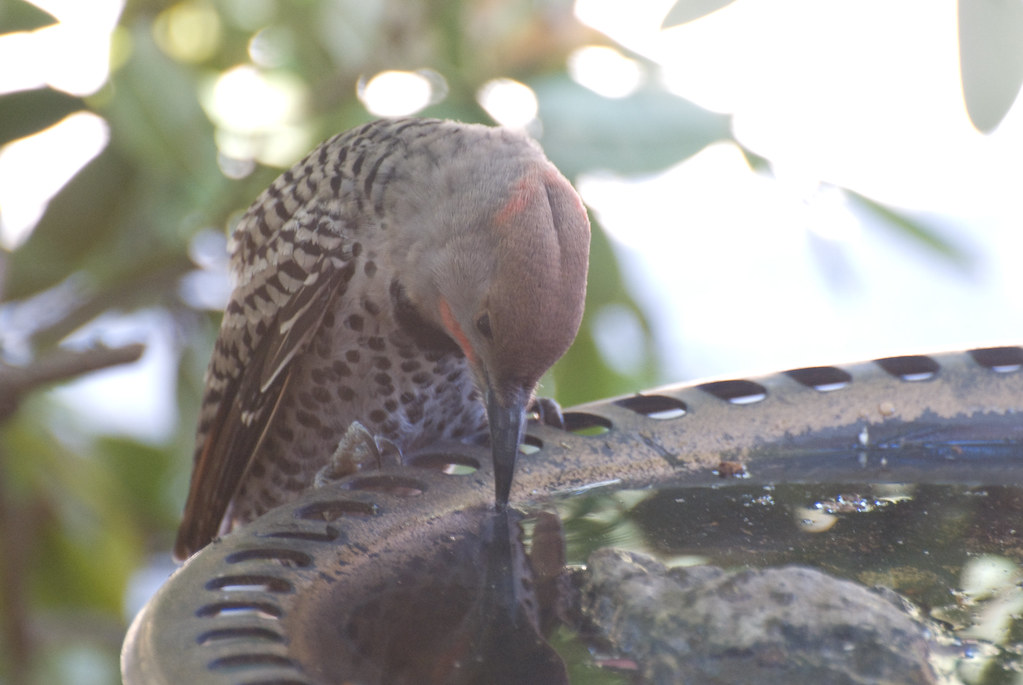
In other news, Pine Siskins and Lesser Goldfinches have been making occasional visits. The (adult female?) Cooper's Hawk that took out our injured Scrub-Jay has been visiting occasionally as well. Our friendly male Red-winged Blackbird has been stopping in every now and again, but we have not seen a Spotted Towhee in some time. Downy Woodpeckers have picked up in number recently, while Northern Flickers have dropped off (heading up into the hills to breed?).
 A Lesser Goldfinch (right) stops in for a bite...
 ... and a Pine Siskin joins in the fun as well.
 A Downy Woodpecker energizes on a cold morning.
We should be seeing more migrants soon, culminating in Wilson's Warblers and Black-headed Grosbeaks in early May. In the meantime, we may see more migrating sparrows (Fox and Lincoln's), wrens, and Cassin's Vireos. We're definitely looking forward to the next two months.
Old Man Winter appears to have finally bitten the dust. Outside of the occasional very light frost, it's definitely Spring now. And with early Spring comes all sort of fun migration and movement.
 One of the most obvious change-of-the-season signs is the molt of the American Goldfinch male from drab yellow/brown to bright yellow, with black cap to boot (above). The females also molt to a less brown hue, but this is less easily recognizable. In addition, our Yellow-rumped Warblers have also been molting into breeding plumage. Two are regularly present now. While some species become more numerous at this time, many exhibit the opposite behavior. Bushtits have decreased their flock size (from 15+ to 4-7) and Anna's Hummers are near-sparse at this point, indicating that they're pairing up for breeding. Our trust White-crowned Sparrow, present every day from early December, has been a no-show since the beginning of the month, indicating that he/she has moved on to breed elsewhere. Dark-eyed Juncos are still present in respectable numbers (5-7 at a time), but definitely lower than what we saw in November-January. They'll slowly trickle away and will be mostly gone at the end of April.
 A male Dark-eyed Junco enjoys some peanuts. If they like what you're feeding, Juncos will gladly eat above ground.
 One of the last photos of our winter resident White-crowned Sparrow.
 A male Yellow-rumped Warbler molting into breeding plumage.
 A male House Finch relaxes in between trips to the sunflower feeder.
 A Bushtit with pollen all over its face.
In addition to the change-of-the-season fun, we've hosted a number of unusual native-winter species as well. This past Saturday afforded both a Cooper's and a Sharp-shinned Hawk in a 7-hour period! They were most likely attracted to the bustling goldfinch activity, and almost certainly our excess of diseased House Finches (which they've done a great job of ridding us of). Over the past couple of weeks, we've had multiple visits from a male Red-winged Blackbird and at least two different Spotted Towhees. Neither are "regular" visitors, but you can count on seeing them at least once a week. A lone Pine Siskin also showed up with a flock of ~20 goldfinches last weekend.
 An adult Sharp-shinned Hawk waits patiently for a meal.
 A Red-winged Blackbird feeds on sunflower seed in the morning fog.
 A Pine Siskin dines with a flock of American Goldfinches.
That's about it for now. We're still waiting on our first Rufous Hummingbird and a possible Purple Finch or two. We'll see what the latter half of March brings...
Well, the seasons they are a' changin' again. The sun is still above the horizon at 5:30 pm, temperatures hit 60 degrees twice last week, and some of our feathered friends are looking a bit different.
 One of the first signs of Spring is the molt of the male American Goldfinch, transitioning from its drab yellow/brown/green winter colors to its well-known bright yellow and black cap. The one pictured above, taken over President's Day weekend, was the only obvious case. Today, there are at least three males that are this far advanced in their molt. One of our two Yellow-rumped Warblers has now revealed itself to be a male (it's difficult to distinguish gender in winter plumage). The stronger gray plumage (below) can be compared to the tan/brown winter plumage.

 Yellow-rumped Warblers. Top: A male in breeding plumage. Bottom: A winter plumage individual.As Spring approaches, early movement also brings new species to the yard. We were pleasantly surprised to see a female Spotted Towhee (below) foraging for seed among the rhododendron bushes. Having lots of brush cover around the yard (and the ground feeder), I'm somewhat surprised that it took this long for one to show up! But late is better than never, and we feel fortunate to host what we do.
 As discussed previously, diseased House Finches (avian pox, conjunctivitis, salmonella, you name it) have been a problem this winter. At one point, we were hosting approximately six diseased individuals. Thankfully, the disease has not appear to spread much (no other species with pox or conjunctivitis have been seen). And, as mentioned two posts ago, predators have been taking out the diseased birds. Two of the more sickly House Finches are gone and I don't believe that I've seen more than two diseased birds at the same time for a couple of weeks now. An individual suffering from the worst case of avian pox that I've ever seen was put out of its misery by a Sharp-shinned Hawk just a week and a half ago. Fortunately, this problem appears to be working itself out.
 A female House Finch with a horrible case of avian pox on the eye. She was mercifully put out of her misery by an immature Sharp-shinned Hawk (below) the day after this photo was taken.
 (Burp!)
 A Robin enjoys a sunny Friday afternoon (yes, I've moved the lawn since).
Despite the changing seasons, they're changing slowly and it's still February. Therefore, our winter "usual suspects" are still around, including our many Dark-eyed Juncos, our two Golden-crowned Sparrows, and our loyal White-crowned Sparrow. After nearly disappearing for over a warmer-than-usual week, our flocks of 15+ Bushtits are back. Other regulars include Scrub Jays, Black-capped Chickadees, Red-breasted Nuthatches, and of course the ever-present Anna's Hummingbirds. Our two species of woodpecker (Northern Flicker and Downy Woodpecker) are still semi-regulars. A White-crowned Sparrow feeds on spilled sunflower seed on the back deck.
 A Golden-crowned Sparrow forages for seed.
More to come in a couple of weeks, when I should (hopefully) have a report of the first Rufous Hummingbird of the year. Laters.
Work has been killing me over the past few weeks, with much traveling and little sleep. But I have managed to look out the window a few times since mid-January and am happy to report an increase in American Goldfinches, Bushtits, and Ruby-crowned Kinglets. And for the first time since September, Pine Siskins (below) have graced us with their presence. Two were spotted and photographed at the sunflower feeder this morning.

Other than that, it's pretty much more of the same. I have a Super Bowl to watch in an hour and a half (Go Colts!) and will be busy with work again at the crack of dawn on Monday. So instead of being wordy, I'll just leave you with some recent photos...
 A White-crowned Sparrow feeds on sunflower seed.
 Western Scrub-Jays continue to visit the yard for peanuts and cracked corn.
 American Goldfinch numbers are up (to 20-30 at a time) and some are even beginning to molt. (Note the dark spot on the crown of the bird on the left perch.)
 Our resident Yellow-rumped Warbler continues to make the rounds.
 A Red-breasted Nuthatch, traveling with a flock of Bushtits, visits the suet feeder.
 One of two Black-capped Chickadees stops in for a peanut.
Here is a summary of what I've been counting for FeederWatch recently. I can't say that I'm disappointed, given that we've only been feeding here for three months.
 (Click chart to enlarge)
Until next time, when I promise that I'll be a little more wordy...
Lots of new and interesting visitors over the past two weeks, including a peek at the avian food chain...
 Hosting an injured bird is always bittersweet. On one hand, you feel sorry for the poor fellow. On the other hand, you feel good that you're able to help prolong the life of an injured creature. But then you get that sinking feeling that it's on borrowed time, and that the other shoe could drop at any second. It's an awkward situation. A couple of weeks ago, I noticed a Scrub-Jay that looked like it was going through some sort of extreme molt. Something was up with its primaries and secondaries (outer wing feathers). Closer inspection showed evidence of a wound, so it's likely that this bird was a victim of predation (most likely from a cat). The jay could fly, but barely, and spent most of its time hopping along our fence, which it used as a springboard to the neighbor's apple tree, where it often roosted. It primarily fed off of cracked corn at our ground feeder.
Late yesterday morning, I noticed a very large figure looming against the gray sky, near the top of the apple tree. My binoculars revealed an adult Cooper's Hawk (above). Surprisingly, after all of the other birds scattered, the injured jay sat perched a few feet below in the same tree. It eventually made an awkward dart for another neighbor's bushes and the hawk followed. After curiously staring into the bushes for a minute, it went in. A few minutes later, the hawk flew across the yard with a large blue and gray mass in its talons. It was somewhat sad to see our jay go, as I had grown fond of him/her out of pity. But at least its demised helped support another bird higher up on the food chain.
 Our injured Scrub-Jay (note the injured wing). R.I.P.
 A Red-winged Blackbird stops in on a rainy day.
 A female/first-year male Purple Finch (background) and female House Finch (foreground).We've been treated to a couple of new visitors lately. A first-time yard visitor for us out on the West Coast arrived earlier in the week: a male Red-winged Blackbird. They tend to prefer marsh area, although they'll wander a bit in the winter and are actually relatively common in the winter/spring in the Eastern half of the country. A couple of days later, we were treated to our first Purple Finch at our new residence. This female/first-year male (they look extremely similar) was around for about 10-15 minutes before flying off. We also began hosting Downy Woodpeckers not long ago and they have become relatively regular since then. In addition, an occasional Ruby-crowned Kinglet has been seen poking around.
 It's nice to see Downies again!
 One of two regular Northern Flickers.
Well, that's about it for now. I'm going to be crazy-busy for the next few weeks, so this will have to suffice until then. See you next month.
Things have really picked up here over the holidays, including our first woodpeckers!
 After over a month and a half of no woodpeckers (not even a Downy!), we were rewarded with TWO Northern Flickers last weekend. This was somewhat surprising, as Downies are more prevalent than Flickers in urban/suburban areas with minimal mature trees. Even more surprising is that one of them was a Red- x Yellow-shafted "Intergrade" (a hybrid of the two subspecies). There are not exactly unheard of out here, but it was a nice surprise. I hosted a similar-looking intergrade juvenile at our previous residence (2 miles away) this summer and am wondering if this is the same bird.

A Northern Flicker stops in for some suet. This individual appears to be a regular now.
 An "Intergrade" Northern Flicker. Note the small red mark on the nape. This individual very well may be the same one that we saw at our previous residence this summer.But Flickers aren't the only story here. A pair of Mourning Doves graced us with their presence a week and a half ago. Some of you Easterners may wonder why I consider this noteworthy, but these were actually the first two first yard Mourning Doves that I've hosted here. They're far from uncommon, but their numbers are far lower here than in the other half of the country. I'm actually somewhat surprised that they haven't returned.
This past weekend was extremely active, owing to a massive amount of flocking. There was a mixed flock of 300+ Starlings and Robins in the neighborhood and, at one time, approximately 200 Starlings in the backyard. Fortunately, that only lasted for a day, and the Starlings appear to have completely moved on (knock on wood). However, it was nice to listen to the calls of Robins for a few days. An added bonus was a small flock of Cedar Waxwings last Saturday. They did little more than perch and occasionally feed in the neighbor's apple tree, but they were a treat nonetheless.
 FeederWatch Data for Fall/Winter 2009. Overall, things are looking up.
 Starlings invade the suet feeder! Thankfully, only for a few days.
 A flock of Waxwings help ease the Starling surge...
 ...and Robins are always a good time.
 "CooOOoo-woo-woo-woooo"
Our "usual suspects" are still out in full force. These include our numerous Juncos and Bushtits, American Goldfinches, House Finches, White- and Golden-crowned Sparrows, noisy Scrub-Jays, our ultra-aggressive Yellow-rumped Warbler, and the elusive-but-regular Ruby-crowned Kinglet. The only downer thus far was the discovery of a House Finch with Avian Pox this morning. Hopefully that doesn't spread.
 Our not-so-friendly Yellow-rumped Warbler is happy to have the feeder all to itself.
 If you have peanuts, you'll have Scrub-Jays.
 Our resident White-crowned Sparrow feeds on millet and cracked corn.
 Actual visual evidence of our elusive Ruby-crowned Kinglet!
I had the opportunity to get out of the yard recently and photo a couple of passerines. The rain and fog hampered my efforts somewhat, but I was able to get really nice photos of a Ruby-crowned Kinglet and a Brown Creeper...

 Well, that's about it for now. I hope that you had a good holiday and here's to a wonderful 2010!