Yard activity has died down somewhat since mid-May, but that's to be expected. And while this is somewhat of a bummer, the weather actually resembles summer now. (Given the miserable spring we've had, I'll take that trade-off for now.) Despite the dispersion of migrants, there has still been some interesting activity.
 Migrants are the most exciting news to me, so I'll discuss those first. Orange-crowned Warblers are our most common migrant summer warbler. They typically begin arriving in mid/late March and hang around through mid-April or so. We were lucky to host more of them than usual this winter. Interestingly, I observed a rather dull individual in late May. After asking around, it was assigned to belong to either an Interior West or Taiga population. At least one person identified it as a celata subspecies, but that is still a somewhat controversial assignment. Either way, it was an interesting observation, as these dull-colored Orange-crowned Warblers are unusual in Lane County.
 A possible celata subspecies Orange-crowned Warbler forages for insects on a late May afternoon.
Flycatchers are some of my favorite summer birds, and I was excited to see a Hammond's Flycatcher back in early May. Thankfully, our two other semi-regular species moved through recently. A Willow Flycatcher was hawking insects in our backyard a week and a half ago. I have also heard Western Wood-Pewee calls over the past couple of weeks (though I have not had the opportunity to photograph one yet). Tree Swallows are regulars in our neighborhood's park, and can sometimes be observed darting after insects around our house early in the morning or late in the evening. So I was rather surprised to see three of them darting around our tiny 1/10 acre backyard on a Saturday afternoon a few weeks ago. One of them even attempted to perch on one of our bird feeders! Also of note were the Black-headed Grosbeaks that hung around the yard until almost mid-June. They typically begin coming through in early May and are mostly gone by the end of the month. I imagine that the unusually cool weather may have pushed their breeding schedules back a couple of weeks.
 A Willow Flycatcher hawks insects on a Saturday afternoon.
 A female Black-headed Grosbeak stops in for sunflower seed.
The other big story has been fledglings. Most importantly, our Black-capped Chickadees fledged at the beginning of the month. Like last year, this happened very abruptly and, due partly to my work schedule and partly to my desire to give them some privacy, I was not able to capture photos this year. (Yeah, I know, I suck.) Perhaps next year.
We have very recently been hosting a fledgling Song Sparrow. Song Sparrows are year-round residents here in the valley, but usually do not breed in urban areas. Other fledglings visiting the yard include Western Scrub-Jays, House Finches, Bushtits (a flock of 15 visited yesterday), Red-winged Blackbirds and, unfortunately, Starlings. The Starlings have forced me to leave the suet feeder empty for a couple more weeks. Interestingly, a lone adult Pine Siskin visited one of the sunflower feeders last night, strongly suggesting that at least one pair is breeding locally. Siskins typically breed in the foothills and mountains, but can often be convinced to breed locally if one provides reliable sunflower or nyjer seed.
 A juvenile Song Sparrow enjoys a refreshing drink on a dry late June afternoon.
 An adult Scrub-Jay (right) feeds its offspring high atop our neighbor's apple tree.
 This late June Pine Siskin appears to be breeding locally.
The most common yard birds right now are House Finches, Red-winged Blackbirds, Western Scrub-Jays, European Starlings, Bushtits, Black-capped Chickadees, American Goldfinches, Lesser Goldfinches, and House Sparrows. Woodpeckers appear to be completely gone and I've seen only occasional Anna's Hummingbirds. We probably won't see regular hummers or woodpeckers until August.
 This male American Goldfinch brightens up a summer evening.
 This male Lesser Goldfinch also helps to brighten up the yard.
 A Black-capped Chickadee cools off on a warm afternoon.
 A Western Scrub-Jay sits atop our fence on the last evening of Spring.
The warm weather also tends to bring out critters. Our local possum has been foraging through spilled seed in the yard more frequently than usual (and sometimes during the middle of the day)...
 Well, that's about it for now. I'm off to take a summer nap, just like Mr. Squirell here...

Yep, it's been a while. Apologies for not posting earlier, but I've been really busy. Thankfully, it's for a good reason this time, rather than illness. While the weather has suggested that we're still stuck in late March, the past month and a half has given us an exciting array of visitors.
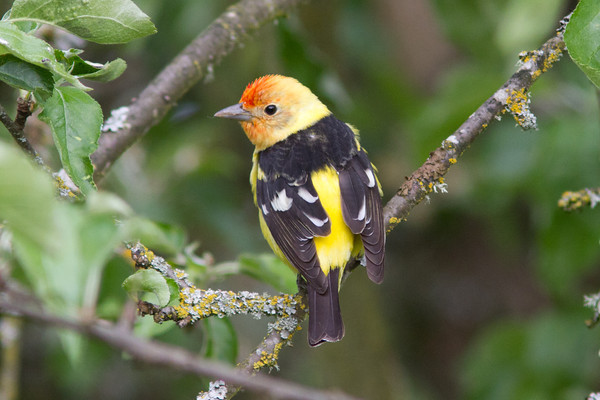
 One of the most interesting stories (in most of Western Oregon, not just our backyard) has been the abundance of Western Tanagers (above). Many people in Eugene and Portland are reporting large flocks of them. While I have not seen flocks, we had quite a few visitors (mostly males) from late April through mid-May. I learned that tanagers enjoy suet, which is always good to know (that gives one extra incentive to keep the suet feeder filled during migration). They are absolutely beautiful birds and we are fortunate to have seen so many this spring.
Also in the Not Expected category was the large number of migratory sparrows that we hosted in late April. I've never hosted this many sparrows before. In the last week of April, we hosted a flock of 20+ White-crowned and at least 5 Golden-crowned Sparrows. My guess is that the combination of cold weather and high precipitation added to the snowpack in the foothills, temporarily delaying them from moving to their breeding ground. In addition, we hosted a Fox Sparrow, a Lincon's Sparrow, and a second Chipping Sparrow (the first visited in late March). It was, by far, the best sparrow spring we've ever had.
 A Fox Sparrow forages through spilled sunflower seed.
 The first yard Lincoln's Sparrow that we've hosted in three years hung around from late April through early May.
 The second of two Chipping Sparrows to visit the yard this spring.
 One of 20+ White-crowned Sparrows that frequented the yard a month ago.
While most of the sparrows (except for the Chipping) were on their way out, many other species moved in earlier in the month. The first of these were the Black-headed Grosbeaks that typically move though in large numbers during the first week of May. They did not show up in the large flocks that we witnessed last May, but their numbers have still been appreciable. Moreover, a couple of them are still visiting on a regular basis three weeks later. This is somewhat unusual, but I'm not complaining. Orange-crowned Warblers were also unusually numerous and conspicuous up until a couple of weeks ago.
Other migrants have made more brief appearances, including a Hammond's Flycatcher, at least one Wilson's Warbler, a number of Warbling Vireos, and a brief appearance by a female Calliope Hummingbird. Calliope Hummers are unusual in this part of the state, but will sometimes hang out in the western part of the state in the spring if the high desert is still cool and soggy. This happened last year and it's not surprising that we're seeing Calliopes again with the Cascade snowpack being over 200% its average level. And just this morning, three Tree Swallows were circling our tiny backyard at eye level. I had never seen that before.
 A second-year male Black-headed Grosbeak stops in for some sunflowerly goodness.
 A male Orange-crowned Warbler forages for insects. Unlike most of my photos, the orange crown is actually conspicuous here.
 This Hammond's Flycatcher was hawking insects in my neighbor's backyard earlier in the month.
 A bad photo of a Warbling Vireo, perched high atop my neighbor's apple tree.
With all of this exciting migratory action, I would be remiss if I didn't discuss the year-round yard regulars. Black-capped Chickadees have once again raised a brood in the nesting box near our front door. The hatchlings can be heard "cheeping" for food throughout the day, even when the window is closed. Due to my hectic schedule, I have not been able to get photos of the parents yet. Red-winged Blackbirds are visiting the feeders frequently, as they did last summer. At least one pair of Brewer's Blackbirds are visiting regularly now as well. Unfortunately, Starlings and their fledglings are ransacking the suet, as they typically do at this time of the year. I let my suet feeder empty for a week to encourage them to disperse. After refilling it this morning, over half of the cake has already been eaten. Perhaps I'll let it sit empty for a couple more weeks.
 A handsome male Brewer's Blackbird struts around the yard.
 One of many regular female Red-winged Blackbird stops in for a snack.
The finch family has also put in a strong showing this spring. We still have a few Pine Siskins hanging around, which is unusual because they tend to breed early and almost always do so up in the foothills. They did breed somewhere near our previous residence, so it would not be a shocker if our plentiful supply of nyjer and sunflower encouraged a pair to do so again. Along with our usual strong showing of American Goldfinches, the Lesser Goldfinches that returned earlier in the spring are still showing up at the feeders semi-regularly. House Finches have been bringing their fledglings to the feeders for at least a week now, and I've also seen an uptick in House Sparrows over the past month. Unfortunately (but understandably), we did not see any Evenings Grosbeaks this month. Oh well, you can't have it all.
 This male Lesser Goldfinch makes our dilapidated trellis look a little nicer.
 A male Western Tanager enjoying suet... before the Starlings showed up.
That's it for now. As we enter the slow (but sunny and enjoyable) part of the year, I hope to see something interesting soon. A Western Wood-pewee, perhaps? We'll see...
Spring is in full swing now. Multiple days in a row of sun without rain, temperatures breaking into the 60s and, most importantly, migrants. The past 2 1/2 weeks have been very impressive and exciting.
 A little over a week ago, I managed to spot the first migrant Orange-crowned Warbler (above) of the season. Two days later, a male and female were busy foraging through our pieris and rhododendron bushes, and at least two of them have been working the bushes for the past week. They tend to not hang around the yard indefinitely, so we're definitely enjoying (and photographing) them while we can. The second big migrants of the season, a Chipping Sparrow, visited the feeders this morning. Chipping Sparrows are low-density migrants in Western Oregon, and (in my experience) do not hang around backyard feeders for very long.Rufous Hummingbirds have been hitting up the nectar feeders since the second week of March, but were conspicuously absent for the remainder of the month. It's possible that I may have been visited by an early outlier that eventually passed through the area. Whatever the case, Rufous visits have become much more frequent over the past week, including at least one female now in the area. And more Rufous visitors means more frequent trips to the nectar feeder, translating to more photo opps!
 A male Rufous Hummingbird visits the nectar feeder on a late Thursday afternoon.
 This migrant Chipping Sparrow stopped in for a brief meal this morning.
In addition to the "true" migrants, there has been a TON of local movement (year-round residents leaving the lowlands to breed in the foothills). We are currently hosting three White-crowned Sparrows and two Golden-crowned Sparrows. This is a significant uptick from the one regular White-crowned Sparrow and the occasional Golden-crowned from this winter. There has also been a significant increase in Red-winged blackbirds and Ruby-crowned Kinglets. The blackbirds will stay throughout the summer, but the kinglets are on their way out. I was fortunate enough to capture a photo of a RC Kinglet attracting a mate..
 A male Ruby-crowned Kinglet shows off its namesake, in an attempt to impress a lady.
 And it turns out that he indeed is the Ladies' Man. Awww, yeah...

 Red-winged Blackbirds have become regulars in the backyard.
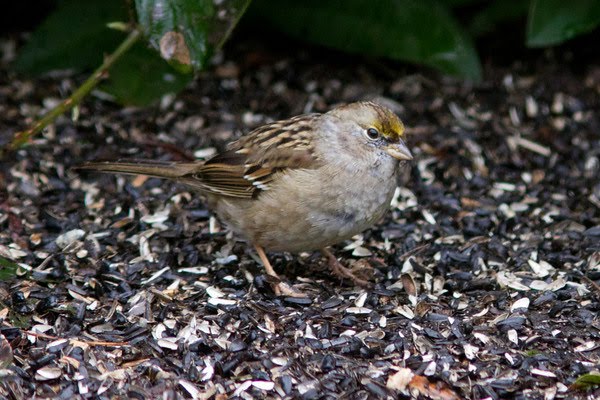
 One of two Golden-crowned Sparrows that have been frequenting the yard. They will likely leave for the hills after their molt is complete.
Late March also brought us a new yard bird: the Brewer's Blackbird. This wasn't a big surprise, and I'm actually surprised that they didn't show up earlier. If you live in an urban area in the Western United States, you've seen Brewer's Blackbirds before. And while we're located in more of an urban/suburban area, we're also two blocks form a park where Brewer's Blackbirds frequent. As long as they don't show up in vast numbers, blackbirds are always welcome in my backyard.
Other interesting recent visitors have included a Red-breasted Nuthatch, a pair of Chestnut-backed Chickadees, a pair of Spotted Towhees, a Mourning Dove (not regular yard visitors here), and a small flock of Cedar Waxwings. In addition, the male Purple Finch that has been a regular since early March is still hanging around. He will likely be on his way within the next couple of weeks.
 A male Brewer's Blackbird snacks on sunflower chips on an early Saturday morning.
 This male Purple Finch has been a regular over the past 5+ weeks.
That's it for now. More migrants are on the way over the next few weeks, and these may include Cassin's Vireo, Warbling Vireo, Western Wood-Pewees, Empid Flycatchers, and Black-headed Grosbeaks. I hope to get photos of at least two of these for the next installment.
I'll leave you with my final FeederWatch results for the 2010-2011 winter. The 36 species observed from mid-November through last weekend was a personal record.


It's darkest before the dawn, as the saying goes. That has certainly been the case here, with nearly-constant rain and headache-inducing gray skies for the past month. But despite all of the meteorological evidence pointing to the contrary, spring has still managed to break through.
 One of the telltale signs of Old Man Winter's demise is the molt of the male American Goldfinch into its bright yellow and black breeding plumage (above). The individual photographed above was a sight for sore eyes on a dreadful mid-March morning. And to make things all the merrier, American Goldfinches have begun flocking in numbers of 15-20 over the past couple of weeks. The bright yellow flocks are a nice way to drive away the gray overcast skies. And speaking of plumage change, I was almost shocked to see an Audubon's subspecies Yellow-rumped Warbler in full breeding plumage hawking insects in the backyard a couple of weeks ago. I can't recall the last time that I saw one advanced this far into its molt before April. This individual is the third Yellow-rumped Warbler to hang out in our yard this winter.
 This breeding plumage "Audubon's" Yellow-rumped Warbler has become a regular.One of the more interesting plumage changes observed recently was that of a second-year White-crowned Sparrow. This individual has been hanging around on-and-off since January. The molt from juvenile to adult plumage is shown in the sequence below. Note the coloring of the crown...
 March 12
 March 19
 March 23
Now, I didn't band this individual, so I can't tell you that it's the same individual beyond the shadow of a doubt. But given the relative lack of White-crowned Sparrows in my neighborhood, the odds of two different molting second-years frequenting my yard is pretty small. The above photos are most likely the same bird.
Of course, mid-March also kicks off the beginning of spring migration. A week and a half ago, a beautiful orange male Rufous Hummingbird was spotted in our butterfly bushes. This individual also visited one of our nectar feeders later that day. However, I have not seen a Rufous Hummer since, indicating that this individual may have been one of the earlier migrants to reach the area. Hopefully I will have multiple Rufous photos to show you next month. My wife may have spotted an Orange-crowned Warbler this afternoon, but couldn't confirm the ID.
 One of the more prominent features of early migration season is local movement. That is, individual birds preparing to move to their breeding grounds (which may be several hundred miles away, or just a couple of miles away). Over the past week and a half, we've been visited by several species that were either infrequent visitors or completely absent in our yard this winter. The Lesser Goldfinch shown above was the first since November. Other recent infrequent visitors have included a Townsend's Warbler, a Ruby-crowned Kinglet, and a Golden-crowned Sparrow. This past weekend, a pair of Chestnut-backed Chickadees stopped in for a bite, presumably on their way to their coniferous breeding grounds in the foothills. And just this morning, a small flock of Cedar Waxwings briefly perched in the neighbor's apple tree. These latter two species had not been observed in the yard since October.
 A recent arrival, this Golden-crowned Sparrow forages for bits of sunflower seed.
 This transient Chestnut-backed Chickadee stops in for some peanuts.
 A Ruby-crowned Kinglet briefly poses for a photograph.
The "regular" visitors have also been out in full force. Dark-eyed Juncos are still hanging around in double-digit numbers. Bushtit flocks have diminished to single-digit numbers, but they're still hitting up the suet feeders frequently. Red-winged Blackbirds have increased in frequency since early February, to the point where I'm typically seeing 2-3 per weekend. Downy Woodpeckers and Northern Flickers have also been visiting more frequently over the past month or so. Pine Siskins have also been regular in small numbers, mixed in with the goldfinch flocks. One of the three male Purple Finches that I've hosted this winter (the only completely healthy one) has also morphed into something of a regular over the past few weeks. I'm seeing him at least once a day now. This has definitely been a banner winter for Purple Finches. I've never hosted them this frequently before.
 One of two "Slate-colored" Dark-eyed Juncos that wintered in our neighborhood
 This second-year male Red-winged Blackbird has become a daily visitor.
 Despite being sometimes pushed around by the more dominant Yellow-rumped Warblers, this "Myrtle" subspecies individual still frequently visits the suet feeders.
 Our regular male Purple Finch hangs out in the neighbor's apple tree before feeding on sunflower.
 A Pine Siskin feeds on a rare sunny afternoon.
Of course, movement works both ways. When some species visit, others go on their way. The two Song Sparrows that visited regularly and frequently this season are apparently gone now. I have not seen either for over two weeks. There has also been a slight drop-off in Varied Thrush numbers. They're still here frequently throughout the day, but I'm seeing more like 2-3 at a time now, instead of 4-5. That said, I can't complain, as this was easily the best Varied Thrush winter I've ever experienced.
 At the risk of going too far off topic, this post is being brought to you by my new 13" MacBook Air (above). With my 2007 15" MacBook Pro experiencing several issues and providing a weak of 1.5 hours of battery life, I decided to spend my bonus money on a new laptop. Rather than pay $2,000 for one of the new MacBook Pros with a solid-state drive and a matte screen, I decided to scale down to a more reasonably-priced 13" model. I miss the extra real estate a bit when I edit photos, but the 13" screen is easily enough for everything else (especially since the Air's screen has the same 1440 x 900 resolution as the Pro). I was originally going to go with the new 13" Pro, but I'm not a fan of the highly-reflective glass screens and the inferior 1280 x 800 resolution. There are a host of other reasons why I went with the Air over the 13" Pro, but I don't want to get bogged down in that. What I will say is that the trade-off in raw power is more than compensated for by the far superior user experience of the Air. Despite it having no optical drive, no FireWire, and only two USB ports, my only real complaint is the lack of a backlit keyboard.
In terms of relevance to this blog, I've found the Air to be more than adequate in handling my primary photo editing apps, Lightroom 3 and Photoshop CS4. I am sure that the Pro's multi-core i5 and i7 processors load and manipulate large RAW files a lot faster than the Air's relatively dinky Core 2 Duo. And that may make a difference if you're a professional photographer and edit hundreds or thousands of files at once. But if you're a hobbyist/enthusiast, this likely won't be a problem for you. I dump my Canon 7D's 25 MB RAW files directly onto an external RAID system and edit them directly from that location via a USB connection. Sure, editing them directly from my laptop's hard drive would be faster, but the trade-off in speed isn't enough to overcome the inconvenience of having to move files to another drive after I edit them. (Incidentally, I noticed only a slight drop-off in throughput when editing RAW files via FireWire 800 and USB 2.0 connections on my old MacBook Pro.) This setup also allows me to get by with a smaller laptop hard drive, which is handy if you're paying top dollar for a solid-state drive. What you lose in processing power from the Air is also (partially) made up for in drive read/write speed. The Air's proprietary solid-state drives are blazing fast. Not surprisingly, the less processor-needy apps that I use at work (Word, Excel, PowerPoint, and Acrobat) all run extremely well on this computer. Oh, and did I mention that it only weighs 2.9 lbs? That comes in handy if you use it both at work and at home. So if you're looking for an affordable Mac (an oxymoron, I know) and aren't into gaming or hardcore HD video editing, definitely take a look at the Air. Despite its size, it's a legit primary computer. One piece of advice: definitely pay the extra $100 to upgrade to 4 GB of RAM. You can never have too much RAM.
OK, enough rambling for now. I'll see you next month, hopefully with more migrant photos.