Sunday, September 25, 2011

Goldfinch Fatigue

Given the way that they flock at this time of the year, I've always associated the month of September with American Goldfinches.  And it's gotten to the point where I sometimes refer to it as "Goldfinch Month."  By approximately mid-September, flocks of 40-50 "AMGOs" at my nyjer and sunflower feeders are commonplace.  Towards the end of the month, their numbers reach or exceed the century mark (I counted 91 in the backyard five minutes ago).  While I appreciate having goldfinches at my feeders (especially the males in their bright yellow breeding plumage), they begin to wear on me at this time of the year.  Not only does it cost me about $25 a week to keep my feeders filled at this time of the year, but much of the spilled seed begins to grow mold and I'm actually forced to excavate and dispose of infected soil and seed under my feeders to keep the area from becoming an avian bioharzard.  (Always a fun time on a Saturday afternoon.)  Thankfully, in a few weeks, the large flocks will thin out significantly and I can return to appreciating the smaller portions of goldfinches.


In the midst of this goldfinch blitzkreig, there have also been a few exciting recent sightings.  A couple of them have literally emerged from the flocks themselves.  On two separate occasions over the past week, I've spotted lone Pine Siskins foraging with them.  Siskins often join flocks of other finches to forage for seed in late summer and fall.  Interestingly, another individual that I stumbled upon while photographing one of these goldfinch flocks was a female Black-throated Gray Warbler.  This was pure coincidence, as warblers do not forage with finches.  Black-throated Gray warblers trickle out slowly in August and September during their fall migration.  I imagine that this individual was the last that I'll see in the yard until May.
One of the many large American Goldfinch flocks that have been hitting up the backyard recently
This female Black-throated Gray Warbler stopped by briefly in the middle of the month
Other notable migrants over the past month have included two visits from at least one female Yellow Warbler and a few visits from transient Warbling Vireos.  An unusual Black-headed Grosbeak that strongly preferred to feed terrestrially (most use feeders) hung around the yard for at least a week and a half, which is unusual during migration.  This individual appeared to be healthy, and hung around until September 9th.  I have not seen a Rufous Hummingbird for at least two weeks.  Some are known to hang around into early October, but I doubt that I'll see another one until March.

This unusual Black-headed Grosbeak hung around the yard for a good week and a half


This female Yellow Warbler was spotted in the neighbor's apple tree at the end of August
Other interesting sightings include a Steller's Jay from last weekend.  Steller's Jays breed in the general area, but not locally in this part of the city.  They typically move from their conifer-dominated breeding grounds (typically outside of town) to other locales in September and October.  A Northern Flicker was observed calling from the top of one of the neighbor's trees at the beginning of the month, but it took until this morning for one to actually visit the feeders.  Interestingly, this individual was a mix of Red- and Yellow-shafted subspecies.  I see mixed-race individuals from time to time (mostly in the winter), but they seem to have gotten more common over the past couple of years.

In terms of local year-round species, Red-breasted Nuthatches and Black-capped Chickadees have been representing in relatively high numbers over the past month.  Chestnut-backed Chickadee numbers, on the other hand, have fallen.  Their movements tend to be unpredictable, so I'm not terribly surprised.  A hatch-year male Anna's Hummingbird has  become a permanent fixture at the nectar feeder, and hopefully he'll hang around for the winter as well.

This hatch-year male Anna's Hummingbird appreciates all of the work that I do maintaining the nectar feeder

This mixed-race Northern Flicker was the first suet visitor of the season
A Red-breasted Nuthatch checks out the neighbor's roof
Chestnut-backed Chickadees have tailed off recently.  Perhaps we'll see more later this fall.
The fall weather moved in last night (along with rain), so changes are definitely afoot.  In the next post, I should have reports of juncos and possibly some southbound sparrows as well.  Perhaps I'll get lucky with some more exotic species, as I did last fall.  See you in a few weeks.

Tuesday, August 30, 2011

An Auspicious Beginning

Sometimes I like to think that I have some sort of "magic touch" when it comes to attracting birds, but the reality seems to be that Eugene's natural habitat and geographic location are more responsible. When we moved into our last house, the yard of which did not contain a single tree, I was concerned about the immediate habitat's ability to attract birds. I was rewarded with two Golden-crowned Sparrows on the day that we moved in and an unusual visit from a White-throated Sparrow the following week. The next fall and winter were banner years for Varied Thrushes, Purple Finches and my favorite, Evening Grosbeaks. Apparently the surrounding area was good enough to overcome that. In contrast, our new home is surrounded by ample mature deciduous and coniferous trees, fruit-bearing trees, and shrubbery. So I'm pretty optimistic about our new yard. And what I've observed during our first month here has justified my optimism.

As mentioned in the previous post, Bewick's Wrens (above) were observed around the yard once or twice at the beginning of the month and we were hoping that they would be regulars. I'm happy to report that they are indeed heard calling almost every day. Given that they're year-round residents, I'm optimistic that they'll hang around. Red-breasted Nuthatches and Chestnut-backed Chickadees have also been regulars in the yard, visiting the feeders and bath daily.

A Red-breasted Nuthatch snatches a sunflower seed.

A Chestnut-backed Chickadee stops in for a drink of water on an unusually-hot August day.

A few new species regular to the area have also appeared recently. In the middle of the month a single male Lesser Goldfinch was observed. It was soon joined by others, including four fledglings a week later. Last week a Downy Woodpecker stopped by for a bite of suet. We will most likely host many more in the next couple of months.

It's the beginning of migration and we've seen more than our share of movement over the past couple of weeks. A week and a half ago, a male Black-throated Gray Warbler briefly stopped in the yard to forage for insects in the photinia bushes. Unfortunately, I wasn't fast enough with the camera. Just an hour later, a male Wilson's Warbler (above) stopped in. It foraged through the same general area, and was present for a good 15 minutes. It was an exciting morning, as it's rare that two migrating warblers visit on the same day, much less within an hour of one another. Black-headed Grosbeaks have been coming through the yard since the second week of August and at least one is still visiting. These are mostly adult females (the males have already moved south), though I have seen at least one hatch-year at the sunflower feeder.

This migrating female Black-headed Grosbeak loads up on calories for her trip South.

This hatch-year Black-headed Grosbeak watches mom feed while waiting his/her turn to use the feeder.

Many other migrants have passed through recently, including a Willow Flycatcher, a Western Wood-Pewee, a Swainson's Thrush, and even a low-flying flock of Canada Geese (a sure sign that summer is on its last legs).

A male Lesser Goldfinch feeds on nyjer on a warm August morning.

Shortly after the adult Lesser Goldfinches found our feeders, they brought their young to the yard.

This American Goldfinch is one of the most frequent birds in the yard. Fledglings have been observed in the yard recently as well.

The August mini-heat wave appears to be over (knock on wood), as I type this on a cool, breezy, overcast afternoon. As summer continues to lose its grip, the yard will become much more active. I hope to have many more stories and photos to share later next month.

Monday, August 15, 2011

New Digs

We're finally moved in to the new place. Aside from the house being a major upgrade, the property itself is much more bird-friendly. We now have a lot more trees and shurbs, including a massive 80-ft-tall black walnut in the front yard, a mature cherry tree along the back deck, and a magnolia tree in the corner of the backyard. Also near that corner area are five arborvitae and two large photinia. Perhaps most importantly, the neighbor's yard is a long, narrow (~150' x 40') lot that is almost entirely a garden surrounded with overgrowth. Species include apple, plum, black walnut, arborvitae, hemlock, and a few others. The surrounding yards also contain two 60' maple-like trees, one of which has almost engulfed a large spruce. There are also three 150' douglas firs two yards away. So not only will there be ample cover for forest-dwelling sparrows and warblers, but the fruit-bearing trees will also likely attract species such as Cedar Waxwing.


Thus far, we've been treated to a couple of species that we haven't hosted with any regularity since our location when this blog began. These include Red-breasted Nuthatches and Black-capped Chickadees. While my guess is that only the former species breeds locally, the habitat here is good for both and it's nice to see them again. Crows are also much more abundant in this area. They wait for cars to run over/break open fallen walnuts in the street and then dine on them. Hummingbirds (both Anna's and Rufous) are in large abundance here, seemingly more so that at our other residences. Other, more "regular" yard visitors have included Western Scrub-Jays, Black-capped Chickadees, Bushtits, House Finches, House Sparrows, and American Goldfinches.

A Rufous Hummingbird makes an early evening visit to the nectar feeder.

The Anna's Hummingbird is currently one of the most frequent yard visitors.

A female Black-headed Grosbeak feeds on sunflower seed on an early August afternoon. Black-headed Grosbeaks are slowly making their way south right now.

This male House Finch enjoys a drink on a warm, dry mid-summer afternoon.

We are delighted to host Chestnut-backed Chickadees once again.

This female Red-breasted Nuthatch stops in for a sunflower seed. We are also overjoyed to see these guys again.

The one downside to this yard, as you may have noticed from some of the pictures above, is the mediocre photo quality that I'm getting at the feeders. This is mostly because the feeders are set back in a shaded area of the yard. Unless I were to put them in the sunny middle of the yard (which would look silly), I'm not going to get awesome photo quality at this distance (30-40'). So I may have to invest in a hunting blind to get closer to my subjects. We'll see.

It's only mid-August, but I've seen some evidence of local and migratory movement. As shown in the photo above, female Black-headed Grosbeaks were semi-regular last week (though not so much this week).
A mature Sharp-shinned Hawk (most likely a female) attempted to nab one of these grosbeaks last week. During our first week here, a pair of Bewick's Wrens were foraging through the neighbor's bushes. We may see more of those in the winter. While Turkey Vultures circling overhead are relatively common out here in the summer, I was surprised to see an Osprey take a few circles over the neighborhood recently. I imagine that it is feeding from the nearby Willamette River.

Well, that's about it for now. As migration ramps up over the next few weeks, I'm sure that I'll have more stories to tell (and hopefully photos to share as well). Until then...

Wednesday, July 27, 2011

Moving On...

It seems like just yesterday that we shut down operations at our previous residence and moved into our current home. But after a little more than a year and a half, we're on the move again. The combination of (partially) deflated housing prices, low interest rates, impending inflation, and our general desire for a larger home convinced us to buy a larger place. It's bittersweet, as I've recorded 60 species in the yard over this relatively short period of time. These have included a rare vagrant American Redstart, a couple of very unusual migrants (Calliope Hummingbird and White-throated Sparrow), numerous unexpected yard migrants (Yellow Warbler, Black-throated Gray Warbler, MacGillivray's Warbler, Hammond's Flycatcher, Willow Flycatcher, Lincoln's Sparrow, and Western Tanager), as well as some wintering species that hung around for much longer than expected (Evening Grosbeaks, Varied Thurshes, and Purple Finches). Black-capped Chickadees raised broods in our nesting box in each of the past two Springs. Birding here has been a tremendous success. While I'll be sad as I take down feeders this weekend, I look forward to setting them up at our new place on Monday morning.

So this is my last post regarding this yard. Thankfully, even in the dog days of summer, there has been ample activity.


After being semi-absent from the yard in June, hummingbirds have returned big-time. Anna's Hummers (shown above) have been visiting the nectar feeder multiple times throughout the day. Fledgling hummingbirds have also been visible. Last week, I spotted a fledgling Rufous Hummingbird begging/nagging its mother for food. That was a first for the yard. Male Rufous Hummers have presumably already headed south, as I have not seen one for some time.

A fledgling Rufous Hummingbird begs Mommy for some grub

This adult female Rufous Hummingbird appears to enjoy the mid-July rain

There has been a surprisingly-good showing of hatch-year birds in the yard this summer, much more so than I remember before. Last week, a juvenile Spotted Towhee was seen scratching around the bushes for food. Fledgling Scrub-Jays and House Finches have been all over the yard this month. Lesser-seen juveniles, such as Lesser Goldfinches and Red-winged Blackbirds have also been conspicuous as of late. Interestingly, a juvenile Northern Flicker also stopped by recently. This was a mix-raced "intergrade" between the Red- and Yellow-shafted subspecies. These individuals are typically more prevalent in the winter, but perhaps a wintering pair decided to nest locally.

A clueless-looking fledgling Red x Yellow-shafted Flicker stops in for... uh... something.

The red mark on the nape shows that this individual is mixed-race

This hatch-year Spotted Towhee scratches around for hidden seed

A hatch-year Western Scrub-Jay raids the peanut feeder, taking as much as possible

Some of the summer usuals have also been hanging around, including Black-capped Chickadees, Bushtits, American Goldfinches, House Sparrows, Starlings (barf!), and a few Brewer's Blackbirds here and there.

Well, that's about it for now. My next report will be next month from our new residence. I hope that there is some yard activity to discuss by then!

Tuesday, June 21, 2011

Late Spring Activity

Yard activity has died down somewhat since mid-May, but that's to be expected. And while this is somewhat of a bummer, the weather actually resembles summer now. (Given the miserable spring we've had, I'll take that trade-off for now.) Despite the dispersion of migrants, there has still been some interesting activity.


Migrants are the most exciting news to me, so I'll discuss those first. Orange-crowned Warblers are our most common migrant summer warbler. They typically begin arriving in mid/late March and hang around through mid-April or so. We were lucky to host more of them than usual this winter. Interestingly, I observed a rather dull individual in late May. After asking around, it was assigned to belong to either an Interior West or Taiga population. At least one person identified it as a celata subspecies, but that is still a somewhat controversial assignment. Either way, it was an interesting observation, as these dull-colored Orange-crowned Warblers are unusual in Lane County.


A possible celata subspecies Orange-crowned Warbler forages for insects on a late May afternoon.

Flycatchers are some of my favorite summer birds, and I was excited to see a Hammond's Flycatcher back in early May. Thankfully, our two other semi-regular species moved through recently. A Willow Flycatcher was hawking insects in our backyard a week and a half ago. I have also heard Western Wood-Pewee calls over the past couple of weeks (though I have not had the opportunity to photograph one yet). Tree Swallows are regulars in our neighborhood's park, and can sometimes be observed darting after insects around our house early in the morning or late in the evening. So I was rather surprised to see three of them darting around our tiny 1/10 acre backyard on a Saturday afternoon a few weeks ago. One of them even attempted to perch on one of our bird feeders! Also of note were the Black-headed Grosbeaks that hung around the yard until almost mid-June. They typically begin coming through in early May and are mostly gone by the end of the month. I imagine that the unusually cool weather may have pushed their breeding schedules back a couple of weeks.


A Willow Flycatcher hawks insects on a Saturday afternoon.


A female Black-headed Grosbeak stops in for sunflower seed.

The other big story has been fledglings. Most importantly, our Black-capped Chickadees fledged at the beginning of the month. Like last year, this happened very abruptly and, due partly to my work schedule and partly to my desire to give them some privacy, I was not able to capture photos this year. (Yeah, I know, I suck.) Perhaps next year.

We have very recently been hosting a fledgling Song Sparrow. Song Sparrows are year-round residents here in the valley, but usually do not breed in urban areas. Other fledglings visiting the yard include Western Scrub-Jays, House Finches, Bushtits (a flock of 15 visited yesterday), Red-winged Blackbirds and, unfortunately, Starlings. The Starlings have forced me to leave the suet feeder empty for a couple more weeks. Interestingly, a lone adult Pine Siskin visited one of the sunflower feeders last night, strongly suggesting that at least one pair is breeding locally. Siskins typically breed in the foothills and mountains, but can often be convinced to breed locally if one provides reliable sunflower or nyjer seed.


A juvenile Song Sparrow enjoys a refreshing drink on a dry late June afternoon.


An adult Scrub-Jay (right) feeds its offspring high atop our neighbor's apple tree.


This late June Pine Siskin appears to be breeding locally.

The most common yard birds right now are House Finches, Red-winged Blackbirds, Western Scrub-Jays, European Starlings, Bushtits, Black-capped Chickadees, American Goldfinches, Lesser Goldfinches, and House Sparrows. Woodpeckers appear to be completely gone and I've seen only occasional Anna's Hummingbirds. We probably won't see regular hummers or woodpeckers until August.


This male American Goldfinch brightens up a summer evening.


This male Lesser Goldfinch also helps to brighten up the yard.


A Black-capped Chickadee cools off on a warm afternoon.


A Western Scrub-Jay sits atop our fence on the last evening of Spring.

The warm weather also tends to bring out critters. Our local possum has been foraging through spilled seed in the yard more frequently than usual (and sometimes during the middle of the day)...


Well, that's about it for now. I'm off to take a summer nap, just like Mr. Squirell here...


Saturday, May 28, 2011

A Cold, Soggy Spring

Yep, it's been a while. Apologies for not posting earlier, but I've been really busy. Thankfully, it's for a good reason this time, rather than illness. While the weather has suggested that we're still stuck in late March, the past month and a half has given us an exciting array of visitors.


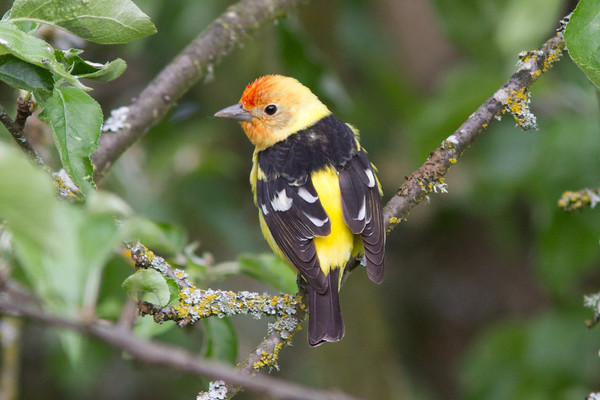
One of the most interesting stories (in most of Western Oregon, not just our backyard) has been the abundance of Western Tanagers (above). Many people in Eugene and Portland are reporting large flocks of them. While I have not seen flocks, we had quite a few visitors (mostly males) from late April through mid-May. I learned that tanagers enjoy suet, which is always good to know (that gives one extra incentive to keep the suet feeder filled during migration). They are absolutely beautiful birds and we are fortunate to have seen so many this spring.

Also in the Not Expected category was the large number of migratory sparrows that we hosted in late April. I've never hosted this many sparrows before. In the last week of April, we hosted a flock of 20+ White-crowned and at least 5 Golden-crowned Sparrows. My guess is that the combination of cold weather and high precipitation added to the snowpack in the foothills, temporarily delaying them from moving to their breeding ground. In addition, we hosted a Fox Sparrow, a Lincon's Sparrow, and a second Chipping Sparrow (the first visited in late March). It was, by far, the best sparrow spring we've ever had.


A Fox Sparrow forages through spilled sunflower seed.


The first yard Lincoln's Sparrow that we've hosted in three years hung around from late April through early May.


The second of two Chipping Sparrows to visit the yard this spring.


One of 20+ White-crowned Sparrows that frequented the yard a month ago.

While most of the sparrows (except for the Chipping) were on their way out, many other species moved in earlier in the month. The first of these were the Black-headed Grosbeaks that typically move though in large numbers during the first week of May. They did not show up in the large flocks that we witnessed last May, but their numbers have still been appreciable. Moreover, a couple of them are still visiting on a regular basis three weeks later. This is somewhat unusual, but I'm not complaining. Orange-crowned Warblers were also unusually numerous and conspicuous up until a couple of weeks ago.

Other migrants have made more brief appearances, including a Hammond's Flycatcher, at least one Wilson's Warbler, a number of Warbling Vireos, and a brief appearance by a female Calliope Hummingbird. Calliope Hummers are unusual in this part of the state, but will sometimes hang out in the western part of the state in the spring if the high desert is still cool and soggy. This happened last year and it's not surprising that we're seeing Calliopes again with the Cascade snowpack being over 200% its average level. And just this morning, three Tree Swallows were circling our tiny backyard at eye level. I had never seen that before.


A second-year male Black-headed Grosbeak stops in for some sunflowerly goodness.


A male Orange-crowned Warbler forages for insects. Unlike most of my photos, the orange crown is actually conspicuous here.


This Hammond's Flycatcher was hawking insects in my neighbor's backyard earlier in the month.


A bad photo of a Warbling Vireo, perched high atop my neighbor's apple tree.

With all of this exciting migratory action, I would be remiss if I didn't discuss the year-round yard regulars. Black-capped Chickadees have once again raised a brood in the nesting box near our front door. The hatchlings can be heard "cheeping" for food throughout the day, even when the window is closed. Due to my hectic schedule, I have not been able to get photos of the parents yet. Red-winged Blackbirds are visiting the feeders frequently, as they did last summer. At least one pair of Brewer's Blackbirds are visiting regularly now as well. Unfortunately, Starlings and their fledglings are ransacking the suet, as they typically do at this time of the year. I let my suet feeder empty for a week to encourage them to disperse. After refilling it this morning, over half of the cake has already been eaten. Perhaps I'll let it sit empty for a couple more weeks.


A handsome male Brewer's Blackbird struts around the yard.


One of many regular female Red-winged Blackbird stops in for a snack.

The finch family has also put in a strong showing this spring. We still have a few Pine Siskins hanging around, which is unusual because they tend to breed early and almost always do so up in the foothills. They did breed somewhere near our previous residence, so it would not be a shocker if our plentiful supply of nyjer and sunflower encouraged a pair to do so again. Along with our usual strong showing of American Goldfinches, the Lesser Goldfinches that returned earlier in the spring are still showing up at the feeders semi-regularly. House Finches have been bringing their fledglings to the feeders for at least a week now, and I've also seen an uptick in House Sparrows over the past month. Unfortunately (but understandably), we did not see any Evenings Grosbeaks this month. Oh well, you can't have it all.


This male Lesser Goldfinch makes our dilapidated trellis look a little nicer.


A male Western Tanager enjoying suet... before the Starlings showed up.

That's it for now. As we enter the slow (but sunny and enjoyable) part of the year, I hope to see something interesting soon. A Western Wood-pewee, perhaps? We'll see...