Saturday, March 10, 2012

Changes

The past couple of weeks have afforded some significant changes, both in the weather and the bird count.  As is typical of mid-March, winter is still lurking but is on its last legs.  The changes, they are a' comin'...


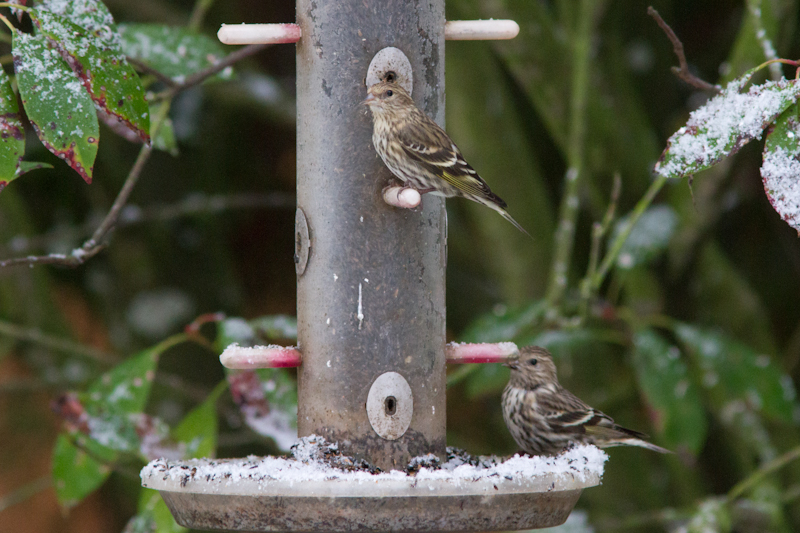
While winter migrants such as Dark-eyed Juncos, Yellow-rumped Warblers, Townsend's Warblers, Pine Siskins, and Varied Thrushes (above) are still present in the yard, their numbers and/or frequency of appearance have dropped significantly in the past two weeks.  Not long ago, flocks of 50+ Pine Siskins jammed the feeders, Varied Thrushes could be spotted in the yard relatively easily, and multiple Townsend's Warblers make frequent trips to the suet feeders throughout the day.  Over the past couple of weeks, the Pine Siskin flock has been diminished to approximately a dozen.  The other aforementioned species have been visiting in much smaller numbers, and less frequently than before.


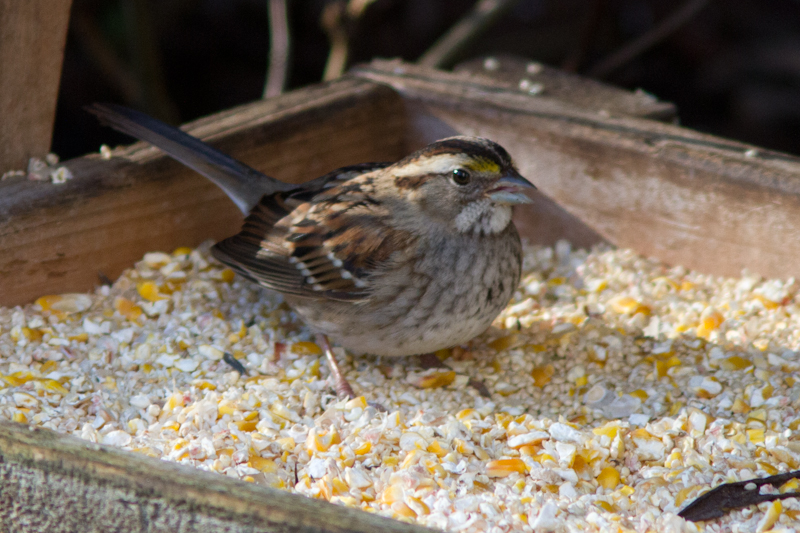
Some other species have been MIA altogether.  I have not seen our two local Bewick's Wrens for almost two weeks, nor have I spotted the two overwintering White-throated Sparrows that have been regulars for the past three months.  The loss of the latter to the seasonal change is understandable, but I'm surprised that the Bewick's Wrens suddenly disappeared.  Perhaps they have chosen to nest elsewhere this year.  Downy Woodpeckers and Chestnut-backed Chickadees have also been MIA over the past couple of weeks.


Heavy snow falls on the morning of March 6th.

Just three days later, sun and temperatures in the 60s bring out the first-of-the-season Rufous Hummingbird.

The past week's weather could be best described as schizophrenic.  March greeted us with sun and temperatures in the 50s and 60s.  Temperatures dropped after the first weekend, accompanied by rain and morning snow.  And then, just a couple of days ago, the sun and 60-degree weather returned... and brought with it our first-of-the-season Rufous Hummingbird.  Rufous Hummingbirds begin arriving on the coast in mid-February, and then typically wait 2-4 weeks to traverse the Coast Range into the Willamette Valley.  Our first March Rufous sighting is highly variable (sometime in between the first and third weeks of the month), so this one was pretty much "on schedule."  I'm pretty sure that the recent warm weather was responsible for its presence.


In addition to the apparent loss of our Bewick's Wrens, more movement at the local level was evident today when the first Ruby-crowned Kinglet (above) since December was observed foraging through our trees.  RC Kinglet movement typically becomes more pronounced in late March/early April, so I was a little surprised to see this guy this morning.

Lesser (left) and American Goldfinches.  This photo gives a nice contrast between the two species.  Note the larger size of the American Goldfinch, the darker coloring of the wings, and the more bronze-like hue to its plumage.

In the midst of our current "bird dought," Northern Flicker numbers have remained high.

Despite the loss of our White-throated Sparrows, the local Song Sparrow still represents at the feeders.


While bird count has been somewhat disappointing lately, at least 15 species have been observed over each of the past two weekends.  So we're still in pretty good shape.  Moreover, March is typically a strong month for yard birds and a rebound towards the mean would be a significant improvement.  Over the next few weeks, I'll be on the lookout for more birds gearing to move into their summer breeding grounds, such as Ruby-crowned Kinglets, Purple Finches, and more Yellow-rumped Warblers.  Chipping Sparrows and female Rufous Hummingbirds should be our next summer migrants, typically arriving later this month.  Until then, good birding...


Sunday, February 19, 2012

An Unconventional Winter

If asked to summarize this winter's yard population in one word, that word would be "unconventional."  Mind you, it's been a great winter and the yard count/diversity has exceeded expectations.  It all just turned out a little differently than I expected.


Some of my predictions, such as an increase in Townsend's Warblers (above) were spot-on, given the overgrowth in the neighbor's yard.  Frequent visits by Bewick's Wrens and Spotted Towhees also seemed to be a no-brainer.

But I never imagined that I'd be hosting 40-50 Pine Siskins (left) per day in a non-irruptive winter.  Nor did I imagine that I'd have a massive dearth of American Goldfinches and House Finches accompanying the insane numbers of siskins.  Don't get me wrong, I'll gladly take the Pine Siskins over those two relatively ho-hum species.  I'm just very surprised.

I was also surprised to have so much trouble attracting woodpeckers from October through early January.  Our new home is in a semi-wooded area, with oak, black walnut, arborvitae, cherry, apple, and even a redwood in the immediate vicinity of our yard.  I hung a tail-prop suet feeder from a branch of the cherry tree next to our deck and saw nothing but warblers at it from late October through December.  The first Downy Woodpecker was observed at it in early January and Northern Flickers began to frequent it soon afterwards.  Now the latter species is there so often that I'm replacing the suet cake weekly!  It sure took them a while to get there, but better late than never.

When one thinks of winter sparrows in the Pacific Northwest, the two that come to mind are the Golden-crowned and White-crowned.  I host at least one or two of each for much of a typical winter.  However, this year, I've recorded one sighting of each just once.  In their place have been two White-throated Sparrows, which are much less common than their aforementioned relatives out here.  Again, I'm not complaining... just a little surprised.  Yesterday, a Fox Sparrow was perched in the neighbor's apple tree.  While Fox Sparrows are common winter residents, I typically don't see them here they begin to move on to their breeding grounds in April and May.  Go figure.

This White-throated Sparrow is one of the many surprises that the Winter of 2011-12 has brought us.

A more conventional Song Sparrow feeds on millet and cracked corn.

One of at least two Northern Flickers who have been frequenting my suet feeder over the past month.

Many of the area's more common visitors have also been on an uptick over the past month.  Bewick's Wren males have been singing since early January and it looks like a pair may be preparing to nest in the area.  At least two of them have been using the feeders frequently over the past few weeks.  Song Sparrows, Red-breasted Nuthatches, and American Crows are also frequenting the feeders more frequently than during the late fall/early winter.

Conversely, Lesser Goldfinch numbers have been falling steadily since early January.  Up until recently, Black-capped Chickadees had always shown up in numbers of 2-4.  But I'm only seeing one at a time now for some reason.  Western Scrub-Jays are also visting the feeders much less frequently than before.  Not sure what the deal is there.  Perhaps a neighbor is offering peanuts in a non-size-selective feeder.

A curious Bewick's Wren nibbles on hulled sunflower bits

Multiple Black-capped Chickadees used to be the norm, but no longer.

This female Anna's Hummingbird stands guard near the nectar feeder.  Soon, she'll have to fight off aggressive Rufous Hummingbirds.

And that pretty much wraps up the past few weeks.  Rufous Hummingbirds began to arrive on the coast about a week ago and they'll begin to traverse the Coast Range into the Valley soon. Our first sighting will likely be between the first and third weeks of March.  I hope to have some nice photos posted by then (and perhaps some more of Evening Grosbeaks and Purple Finches).  Until then...


Tuesday, January 31, 2012

FinchFest

After moving into this house in August, I figured that it'd take a good year or so for my yard to become fully "established" with the locals.  Turns out that it only took five months.  The past two weekends in particular have been incredibly kind to me...


Evening Grosbeaks (above) may just be my favorite bird.  Growing up in the Midwest, I would hope and hope that a flock would show up to my sunflower feeder on a winter day.  Alas, it never materialized.  I didn't have a chance to see one until moving to the Pacific Northwest... and getting one to visit the backyard is an even greater challenge (especially if you live in an urban area).  Fortunately, the conifer seed crop in the Central Cascades was bad last fall, and this forced many seed-eating finches into the Valley.  This irruptive movement allowed us to enjoy semi-regular Evening Grosbeaks from October into January of last year.  Without the benefit of a massive seed crop failure, I figured that my chances of seeing one any time soon were very low.  So imagine how surprised I was to find FOUR males perched in my neighbor's tree this past Saturday morning.  They visited the feeders throughout the day but, in true unpredictable Evening Grosbeak fashion, I have not seen them since.

This past Sunday, I was pleasantly surprised to see a female/immature male Purple Finch foraging on spilled sunflower chips.  Purple Finches are unusual but regular winter season visitors.  However, they tend to appear in backyards mostly when moving out of their local wintering habitats in March or April (or, less commonly, when moving out of their breeding habitats in October.)  That said, I have hosted January Purple Finches over the past two years, so I'm not shocked.  In other finch news, flocks of 50+ Pine Siskins have been dominating the yard for the past two weekends.  If I didn't know any better, I'd think that this was a second consecutive irruptive finch year.

A Purple Finch feeds on spilled sunflower chips

Flocks of 50+ Pine Siskins forage under the sunflower feeder

Varied Thrushes winter West of the Cascades in numbers that vary yearly.  These numbers can range from a bona-fide irruption (last winter) to few or none (2009-2010).  Local snowfall can trigger movement out of the Cascade foothills, and this appears to be what happened a couple of weeks ago.  Thankfully, the "snow refugees" have decided to stick around for a while.  At least four have been regularly visiting the yard since mid-January, and I'm very thankful for them.

A male Varied Thrush forages through the backyard on a January afternoon

Although I have not seen many of the "normal" wintering sparrows (Golden-crowned and White-crowned), I have been very fortunate to host two White-throated Sparrows over the past month or so.  And both continue to visit the millet/cracked corn ground feeder.  We continue to host at least two Spotted Towhees as well.

This tan-striped morph White-throated Sparrow has become a regular

Dark-eyed "Oregon" Juncos continue to represent in appreciable numbers, though more modest since November

Other species of note include a recent uptick in Downy Woodpecker and Northern Flicker numbers.  At least one Chestnut-backed Chickadee continues to visit regularly, and I was also pleased to host two Red-breasted Nuthatches this past weekend.  They had been scarce for some time.  Yellow-rumped and Townsend's Warbler numbers have fallen off slightly, though both species continue to visit the suet feeders multiple times per day.  Our local Bewick's Wren (who refuses to pose for a photo!) has also been visiting the feeders very frequently.

Interestingly, American Goldfinch and House Finch numbers have been ridiculously low this winter.  I'm not complaining - just a little confused.

One of two Red-breasted Nuthatches that returned to the feeders after a long absence

A Varied Thrush forages in the back corner of our yard.  Note how well he blends into the dark blue and orange of the decomposing leaves.

A temporarily-uncommon American Goldfinch stops in for some sunflower seed.  Note the molt to black feathers on the cap - spring isn't far away!

I'll leave you with a summary of my FeederWatch counts for the first half of the winter season.  Not bad...


Monday, January 16, 2012

Winter in Full Swing

We've had winter temperatures for about a month and a half now, with morning temperatures in the low/mid 20's last week.  But winter wouldn't be winter without a little snow.  So it was certainly nice to wake up to a lightly-dusted lawn these past two mornings!  Light snow in the valley also means significant snow cover in the foothills... which means more birds in the valley and an exciting time at the feeders.


Winter has really settled in over the past few weeks, and this has been reflected by the abundance and behavior of our wintering warblers.  Back in mid-November, it was relatively easy to spot 4-5 Yellow-rumped Warblers hawking insects, visting the suet feeders, and vying over territory.  But as their migratory movement has died down, the Yellow-rumps have thinned out and a maximum of two at a time can be observed around the yard now.  Townsend's Warblers (above) weren't regular suet-eaters until December, and even then could infrequently be observed at the feeders.  But now there is at least one male and one female that visit the suet feeders several times per day.  As the weather has rendered insects far less abundant, suet has become a much greater part of the Townsends' diet.

A Yellow-rumped Warbler visits the yard for a bite of suet

The cold and snow have also directed other species to our backyard.  It is more than just coincidence that a female Varied Thrush happened to appear in our backyard yesterday morning, after the winter's first appreciable snow accumulation under 2000' in the foothills.  Varied Thrushes spend the winter foraging the floors of coniferous forests in the foothills.  When their feeding grounds get buried under several inches of snow, they often head into the valley.  Downy Woodpeckers and Northers Flickers, insectivores who only occasionally visited the yard in October and November, are both hitting up the suet feeders much more often now.  Bewick's Wrens, which had become somewhat elusive back in the fall, have now returned to take advantage of my peanut feeder.  Of course, they can be very difficult to spot (and photograph).  But if you're patient, you'll see one dart into the peanut feeder, select a nut, and dart back into the bush at least once a day.  We also hosted our first-of-the-winter Slate-colored Junco at the end of December.  They winter in small numbers out here.

A female Varied Thrush forages through the yard the morning after a major snowfall.

Pine Siskins converge on a snowy January morning.

There have been upticks in other species as well.  A month ago, I was only seeing one or two Pine Siskins feeding with a flock of Lesser Goldfinches.  Now I'm hosting homogeneous flocks of 10-20 siskins.  I am also hosting at least two Spotted Towhees now, and I regularly see at least one per weekend.  Remember when yard towhee sightings were very infrequent?  I'm glad that those days are gone. ;)

Wintering sparrows are usually a big part of the backyard feeding station.  Though this winter has not been great for sparrows in general, I've been fortunate enough to host a White-throated Sparrow since mid-November.  White-throats are pretty common winter feeder visitors in the Eastern half of the county, but not so much out here on the West Coast.  The wintering populations here are relatively small, and they're a somewhat-noteworthy find.  Two weeks ago, a second White-throated Sparrow appeared at the cracked corn/millet feeder.  This one is a tan-striped morph, so now I have one of each type!  My first White-crowned Sparrow of the winter appeared last weekend, but I haven't seen it since.

My "regular" white-striped morph White-throated Sparrow was recently joined by a...

tan-striped morph White-throated Sparrow.  This is an uncommon wintering species on the West Coast.

Not to be left out, this immature White-crowned Sparrow also joined in on the fun.

While things are going great here for a first winter at a new home, there are a few species that seem to be "lagging" behind in number.  Red-breasted Nuthatches have been conspicuously absent for much of the fall and winter, especially considering how frequently they were observed here in the late summer.  This area is not overly-coniferous, but contains enough pine and fir to attract regular Chestnut-backed Chickadees.  American Goldfinches and House Finches also continue to represent in puzzlingly-small numbers.  I was burned out by the former by early October and don't really care much for the latter (they're a half a step down from House Sparrows, in my opinion), but I'm still at a loss to understand why so few have been around.

Well, that's it for now.  I hope to report (and photograph) the yard's first Purple Finch soon.  (March or early April would be a better bet, but I've been known to get lucky now and again.)

Friday, December 23, 2011

Merry Christmas!

The past few weeks have been an exciting time!  Many of the winter regulars have finally settled in, and a couple of winter irregulars have decided to stick around.


The White-throated Sparrow (above) that was first spotted in the yard on November 11th appears that it will likely overwinter in the neighborhood.  I wasn't expecting this, as most WC Sparrows winter closer to the coast.  In fact, the last individual that I hosted (late Novemeber/early December, 2009) only hung around for a couple of weeks.  But the brightly-colored individual shown above has been showing up multiple times per day since then and doesn't appear to be moving on any time soon.

While winter sparrow numbers have been down overall this winter (no White-crowned, Lincoln's, or Fox; and just one Golden-crowned last month), the presence of year-round sparrow species has been impressive.  Specifically, we've hosted at least one semi-regular Song Sparrow since early November.  Even more impressively, there are at least two local Spotted Towhees that are now feeding in the yard regularly.  This is the first residence where I've had the fortune to see towhees on a regular basis.  And I'm very thankful for that, as they're one of my favorite yard birds.

A Song Sparrow feeds on a mixture of white millet and cracked corn.

A Spotted Towhee cautiously stops in for a quick morning snack.

When we purchased this house, I was pretty confident that the yard and surrounding area would support warblers, kinglets, and wrens.  And my instincts were relatively accurate.  Before the moving truck brought over our furniture, I had spotted one or more Bewick's Wrens, and there were several sightings of migrating warblers (Wilson's, Yellow, and Black-throated Gray) from mid-August through September.  When late October rolled around, Yellow-rumped Warblers could be seen hawking insects around the neighborhood.  Townsend's Warblers soon followed.  While the YR Warblers became frequent visitors at the suet feeders and the Wax-myrtle bushes, the Townsend's Warblers continued to visit only occasionally (perhaps once a day) and largely avoid the feeders.  And then it got cold.  With lows in the mid-20s in early December, much of the insect population was eliminated and we currently have at least one regular male and one female at the suet feeders.  Townsend's Warblers are another one of my favorites and these bright yellow friends are always a pleasure to see on a gray, overcast winter day.

This Yellow-rumped Warbler sits atop one of our Wax-myrtle shrubs on a cold December morning.

A male Townsend's Warbler hits up the caged suet feeder.

We have also been fortunate with kinglets and wrens this fall.  Both Ruby-crowned and Golden-crowned Kinglets exhibit major movements through our area in November.  This year was no exception, as both were frequently observed in mixed flocks with Bushtits and Chickadees last month.  As is usually the case, GC Kinglets move on to winter in more rural areas in December, while some RC Kinglets stick around suet feeders in urban and suburan areas.  Though I'm seeing far fewer RC Kinglets than I did a few weeks ago, one was taking suet at one of the feeders earlier this week.  Hopefully it will become a semi-regular this winter.  The Bewick's Wrens that frequented the yard late this summer became far less conspicuous in the early fall.  However, they've made a major comeback and seem to enjoy my new peanut feeder.  I had hoped to get a good photo of at least one of these three species, but they're all rather difficult to capture.

A Western Scrub-Jay stops in for some cracked corn.

This Pine Siskin is one of two that have visited the yard recently.  Will more winter finches be on the way?

This male Downy Woodpecker checks out the magnolia tree after enjoying a suet lunch.  Woodpeckers have been scarce here so far.

After being regulars in the late summer, Red-breasted Nuthatches seemed to drop off the face of the Earth this fall.  Thankfully, they're resurged over the past two weeks and can be seen at the feeders about once or twice a day now.  Chestnut-backed Chickadee numbers dropped a little over the same time, but there has always been at least one around over the past four months.  Now there are two regulars.

On the other hand, winter regulars for this area, such as Downy Woodpeckers, Northern Flickers, and Pine Siskins, have all been in low number this season.  Siskins numbers are always unpredictable, but I'm somewhat surprised to see so few woodpeckers.  Perhaps January and February will provide us with more.  Evening Grosbeaks, Purple Finches, and Varied Thrushes - all of which were regular to semi-regular last winter due to irruptive movements - have been absent this season (save for one Varied Thrush).  I would expect to see a Purple Finch or two in March or April, when they typically exhibit local movement, but probably not the other two species.

So, that's it for now.  I hope to have more good news in January.  Until then, Merry Christmas and Happy New Year!

Sunday, December 4, 2011

A Late Autumn Surge

The past three weeks have been quite exciting!  We are coming off of an impressive surge in winter movement, which has primarily included warblers and kinglets.  However, various members of the sparrow family have also been representing in the backyard.  Fortunately, I've been able to break away from real-world responsibilities to chronicle the activity.


One constant of winter in much of the country is the Yellow-rumped Warbler.  They inundate much of the coasts, South, and Southwest at this time of the year and have a voracious appetite for suet.  And if you happen to have Wax-myrtle bushes in your yard (as we do, shown above), they love the berries as well.  In fact, they're one of the few species of birds that can digest the waxy substance that coats the berries.  Yellow-rumps began flocking in the area a little over a month ago, primarily hawking insects.  The initial wave was primarily the "Myrtle" subspecies that primarily winters on the coast.  Over the past couple of weeks, I've observed more of the Western "Audubon's" subspecies, with a few Myrtles still hanging around.


A male Townsend's Warbler stops in for a bite of suet

This Ruby-crowned Kinglet has been busy foraging for insects in the neighborhood

Our other regular winter warbler, the Townsend's (shown above), has also been visiting semi-regularly.  Townsend's Warblers are far less numerous than Yellow-rumps at this time of the year and are far from a lock to visit suet and peanut feeders regularly throughout the winter.  At this point, I'm seeing at least one a day foraging in a mixed flock, with Bushtits, kinglets, and Yellow-rumped Warblers.  One will occasionally come to a feeder.  It'll be interesting to see how things shake out as winter progresses.

Kinglets tend to exhibit major movements into the Willamette Valley in mid- and late-November, and this year was no exception.  Golden-crowned Kinglets tend to move through and settle in rural areas, while many Ruby-crowned Kinglets (shown above) settle in urban/suburban areas, where they forage for small insects/spiders and take suet from feeders.  Ruby-crowned Kinglets haven't yet visited my suet feeders, but have been observed foraging for insects in the area multiple times per day for the past couple of weeks. Golden-crowned Kinglets tend to move through quickly over the course of a week, and that's pretty much what happened last weekend.  Surprisingly, I managed to count at least three (possibly more) foraging in my neighbor's yard last weekend.  Golden-crowned Kinglets are constantly moving and are a nightmare to photograph, so I don't have any photos to share. :(

A really poor photo of the first Varied Thrush of the winter season

Other winter visitors observed recently include a Golden-crowned Sparrow, a Song Sparrow, two Spotted Towhees, a Pacific Wren, and a single Varied Thrush.  (We may see more Varied Thrushes over the next month or two.)  Large flocks of Cedar Waxwings roamed the neighborhood for the last half of November.  The White-throated Sparrow reported in the last post is still hanging around.

After a banner winter last year, finches have been conspicuously absent from the yard this season.  A poor conifer seed crop in the Cascades lead to higher-than-usual numbers of Pine Siskins and Purple Finches last winter, and even semi-regular visits from Evening Grosbeaks.  This fall has given us just the opposite.  Not only have none of the above been observed at the feeders, but House Finch numbers are way down.  Even more surprising is that I have not seen more than one American Goldfinch since mid-October and have not seen a single individual for the past three weeks.  Interestingly, we *have* been hosting an unusually large number of Lesser Goldfinches (left).  I imagine that American Goldfinches will begin to flock at the feeders at some point, but I'm not banking on hosting flocks of siskins or grosbeaks again this winter.


Other species that have been conspicuously absent include Red-breasted Nuthatches and Downy Woodpeckers.  Red-breasted Nuthatches were regulars in the late summer and early fall, but the locals are apparently wintering elsewhere for some reason.  I'm also at a loss to explain the lack of Downy Woodpeckers.  The surrounding neighborhood is more than adequate habitat for them.  Northern Flickers have been conspicuously loud around the neighborhood for at least a month now, but have only been occasional visitors to the suet feeder.  I am hopeful that all three species will represent in larger numbers over the next few months.


A confused Northern Flicker wonders where the old, easy-to-use feeder went...

... but doesn't take long to adapt to this one.  They're very intelligent birds.

At this point, our most frequent visitor is the Dark-eyed Junco.  Small flocks (6-12) are common throughout the day.  Coming in a close second are Anna's Hummingbirds, with at least three individuals being a near-constant presence.  Flocks of 5-10 American Crows pick through our piles of yard waste for black walnuts.

A female Anna's Hummingbird guards the nectar feeder from a nearby shrub

One of the many Dark-eyed Juncos that regularly visit the yard

Well, that's about it for now.  The past few weeks have been great, but I hope to have some winter finches, woodpeckers, and nuthatches to report later this month.  Until then, have a Merry Christmas and Happy Hanukkah!


Saturday, November 12, 2011

More Migrants

Activity has been down for the past few weeks, which is one reason why I haven't posted in almost a month.  Fortunately, things really began to pick up last weekend.  Overall numbers are still not great, but the lack of quantity is greatly overshadowed by quality of species we've been hosting.


We are currently hosting this uncommon migrant White-throated Sparrow.


One of our more interesting visitors has been a beautiful white-striped morph White-throated Sparrow (above).  This individual, first observed yesterday morning, was a pleasant surprise, as they are rather uncommon winter migrants.  (The last one that we hosted was two years ago, at our previous residence.)  White-throated Sparrows tend to congregate on the coast, so this one may not hang around much longer than a week or so.  At least one Song Sparrow has also been infrequently feeding in the yard.  Song Sparrows are year-round residents here, but are only regulars in urban areas from the late fall through the early spring.


Our two species of wintering warblers, the Townsend's and Yellow-rumped, have also been frequenting the yard for at least a week.  Neither are taking suet right now, indicating that insects are still in ample supply.


A male Townsend's Warbler, apparently tired of consuming bugs, darts off with a peanut.

This Yellow-rumped Warbler forages for insects in the neighbor's apple tree.

One interesting turn of events has been the turnover from American to Lesser Goldfinches.  We were recently inundated with flocks of 100+ American Goldfinches, but they have almost all moved on (only one individual remains).  In their place, a much smaller flock (< 10) of Lesser Goldfinches has been frequenting the nyjer and hulled sunflower feeders.  This has been a nice change of pace.  As much as I enjoy American Goldfinches, the large flocks were just too much.  I hope to see more moderate flocks of them in another month or so.


Our other regulars at this time include Dark-eyed Juncos (of course), Black-capped Chickadees, Bushtits, Scrub-Jays and Crows, who are devouring the walnuts that have fallen from our tree in the front yard.  Interestingly, Chestnut-backed Chickadees are semi-regular at this point.  Expected species that have not been showing up yet include Red-breasted Nuthatches, Downy Woodpeckers, and Northern Flickers.  I hope to see them soon.


A small flock of Lesser Goldfinches feed on hulled sunflower seed.

 A female Anna's Hummingbird guards the nectar feeder from a nearby bush.

We were pleasantly surprised to see our first Cooper's Hawk of the new house last Saturday, a small-ish male.  Interestingly, he showed up at the end of the afternoon, after the vast majority of birds had already left.  Raptors are majestic and I can never get enough of them.  We also appear to have a regular Western Gray Squirrel.  This individual has been hanging around for the past few weeks and doesn't appear to be going anywhere.  As much as I dislike squirrels eating seed that I put out for birds, it's always nice to see a Western Gray Squirrel thrive in an area where the more numerous Fox Squirrels have driven most of them out.

A male Cooper's Hawk searches for a meal in the rain.

Our resident Western Gray Squirrel feeds on an apple from the neighbor's tree.

Well, that's about it for now.  I hope to see some more wintering sparrows and perhaps a small flock of Pine Siskins in the next month or so.  Until then...