Thursday, May 31, 2012

Malheur NWR Trip

I don't normally post notes and photographs from the field in this blog.  (Perhaps I will create a dedicated page for that at a later date.)  But with migration movement being minimal here in Western Oregon, my yard is as dead as a doornail at this point.  So I figured why not share some photos from my recent trip to Malheur National Wildlife Refuge.  And, heck, it's pretty much impossible to not take a ton of photos of interesting birds at Malheur.


Malheur NWR is located in the high desert (elevation of over 4000 ft) of southeast Oregon, approximately 25 miles south of the town of Burns and roughly 100 miles north of the Nevada border.  The refuge is roughly t-shaped, with the northern end consisting of Malheur, Mud, and Harney Lakes, and a relatively narrow strip of land extending approximately 30 miles to the south, ending near the town of Frenchglen.  Much of this area consists of small lakes, ponds, and marshes.  (Being that this is desert region, I'd imagine that at least some of the marshland is seasonal.)  The abundance of water in such a dry area attracts ridiculous number of birds (over 320 species recorded), particularly during spring migration.  And the birds attract nerds such as myself.


The Yellow-headed Blackbird is one of the most common migrants at Malheur.

Not surprisingly, waterfowl and shorebirds are big here.  As I drove past Malheur Lake and the surrounding marsh area on my drive into the refuge on Sunday afternoon, American Avocet, American Coot, Black-necked Stilts, Wilson's Phalaropes, White-faced Ibis, Great Egret, Killdeer, Forster's and Caspian Terns, sandpipers, pelicans, and several species of duck were prominent.

American Avocet

Black-necked Stilt

White-faced Ibis

Wilson's Phalarope

Forster's Tern

Long-billed Curlew


Great Egret

Fledgling Killdeer

While traveling through some of the marshland south of Malheur Lake, this ostrich-looking individual was observed in an adjacent field...


It shortly revealed itself to be a Sandhill Crane...


An abundance of water means an abundance of insects.  And these insects attract vast numbers of insect-eating migrants, such as swallows and flycatchers.  Swallows were in such high abundance at times that they reminded me of the swarms of insects that I used to encounter on summer evenings in Indiana.  (Thankfully, no swallows were killed by my windshield.)  Tyrant flycatchers such as kingbirds, phoebes, pewees, and a few species of the Empidonax genus were also abundant (though not nearly as numerous as the swallows).

Barn Swallow

Tree Swallow

Bank Swallow.  Widespread, but in small, isolated populations that are not readily observed.

Western Wood-pewee

Eastern Kingbirds are not common in Oregon, but a small number do breed in the Eastern portion of the state.

I stayed with three other birders at the Malheur Field Station (MFS), which was also very flycatcher-happy.  The Western Kingbird below is a big fan of MFS.


Our mobile home was equipped with small platforms under the awnings, wich made for convenient nesting spots.  A pair of Say's Phoebes took advantage of the nesting spot next to our front door, and didn't seem to be bothered by our presence.

One Say's Phoebe hawks insects around the parking lot...

... while the other tends to nest duties.

Common Nighthawks can also be found in the area.  These birds aerially forage for insects and are most active at dusk and dawn.  During the day, they can often be found resting/napping on horizontal tree branches, fences, signs, etc.

 A Common Nighthawk rests on a fence.

Warblers enjoy insects as well, and it was difficult to not see Yellow Warblers on the refuge.  Several dozen of them could be seen in relatively small areas, and it was getting to the point where I could hear their songs in my sleep.  Some of the brushier habitats were also good for Yellow-breasted Chat.

A male Yellow Warbler sings atop a small tree at Benson Pond.

This Yellow-breasted Chat pops up for a second.

Malheur is also home to many small rodents (mice, voles, etc.), which attracts raptors and other predatory birds...

 
Great-horned Owls

Immature Red-tailed Hawk

Nestling Golden Eagle

Loggerhead Shrike

The raptor-heavy grassland habitats were also good for species such as Bobolink and Horned Lark.  We even spotted a late migrant Lewis's Woodpecker in this unexpected habitat.  Black-billed Magpies were abundant in areas closer to human habitation.

Bobolink

Black-billed Magpie

An uncooperative Lewis's Woodpecker keeps its distance from us.

One of Malheur's big attractions is the refuge's headquarters.  Located on the south end of Malheur Lake, its large oasis of trees act as a magnet for migrant passerines (perching birds).  Headquarters was jam-packed with Western Tanagers, Yellow-headed Blackbirds, Bullock's Orioles, Cedar Waxwings, Yellow Warblers, Warbling Vireos, among others.

Malheur NWR Headquarters

Western Tanager, male

Warbling Vireo

Bullock's Oriole (appears to be a second-year male)

Cedar Waxwing

California Quail, male

Lazuli Bunting, male

Hummingbirds were also abundant at the nectar feeders at Headquarters.  Male and female Black-chinned Hummingbirds, shown below, were omnipresent:


As the migratory movement of the "regular" Western birds begins to taper out in late May, vagrant Eastern species sometimes begin to appear.  We were fortunate enough to observe a few...

Baltimore Oriole, male

Black-and-white Warbler

Rose-breasted Grosbeak

We also observed a female Northern Parula.  I was not able to get a good photo of it, but Portland birder Diana Byrne obtained both a good photo and a video.

I'd like to thank Alan Contreras and Vjera and Eddie Thompson for letting me stay with them, as well as for their ID assistance, cooking, and camaraderie.  I'd also like to thank Alan for carting us around all day Monday, and for making frequent stops to allow me to obtain many of the photos shown above.

Saturday, May 12, 2012

Migrant Wave Continues

This spring is shaping up to be the best year for yard migrants that I've ever experienced.  While the tidal wave of some migrants, such as the Orange-crowned Warbler (below), has subsided, the past two weeks have brought us an exciting influx of others.


I've been particularly fortunate to see a few really uncommon yard migrants over the past couple of weeks.  Two days ago, a male Calliope Hummingbird made an appearance at my nectar feeder.  Calliope are very uncommon-but-annual spring migrants here in the Willamette Valley.  While most take an inland route to their breeding grounds in the high desert of the inland Northwest, some migrate up the Pacific coast and then traverse the Cascades.  There seems to be a higher-than-usual number of Calliope in the Willamette Valley right now.  This may be due to our cool, soggy spring forcing more of them to use the Pacific coast migratory route.  The streaked iridescent fuchsia on the male's throat is unmistakeable - it's like a psychedelic ZZ Top beard on a tiny bird, if you can imagine that.  Calliope are more diminutive than our regular Anna's and Rufous Hummers, and also have very short, flat tails.  Interestingly, I've hosted Calliope in each of the past three springs (which have all been on the cool and soggy side).

This male Calliope Hummingbird is a very uncommon migrant in our area.

The second piece of big news involves a regular summer breeder that is much less common at backyard feeders than its Eastern cousin.  Unlike the Indigo Buntings that are native east of the Rockies, Lazuli Buntings tend to shy away from urban areas.  They gravitate towards rural meadows, often at higher elevations.  So I was very surprised (and pleased!) to spot a timid female feeding on millet that I dumped on the ground for the sparrows last week.  This is the first yard Lazuli that I've hosted in six years of living out here.  This individual was skittish that I took photographs from behind my semi-dirty windows:

A timid female Lazuli Bunting cautiously surveys the yard before coming down to feed.

I was also somewhat surprised to see a Swainson's Thrush feeding on berries in my neighbor's ivy patch this morning.  Swainson's Thrushes are semi-common yard migrants in May and late August/early September, though they're far from a lock to visit.  They also like to stay buried in dense foliage and are thus difficult to photograph.

As I mentioned earlier, the influx of many species of warblers appears to have subsided.  However, Wilson's Warblers can are still semi-regularly visible in the neighborhood.  A whopping number of 24 were reported at Skinner Butte (downtown) this morning.  I'm not sure why, but this seems to be a banner year for them.

A male Wilson's Warbler finds a grub in the neighbor's yard.

This Swainson's Thrush enjoys berries on a Saturday morning.

Two weeks ago, I was excited to spot a Pacific-slope Flycatcher hawking insects from multiple neighors' trees.  Pacific-slopes are one of three Empidonax flycatchers that breed locally (Hammond's and Willow are the other two) and I had never hosted a Pacific-slope in my yard before.  However, my excitement soon turned to frustration because I was unable to get a halfway decent photograph of the individual.  Many species of Tyrant Flycatchers hawk insects from out in the open, but Pacific-slopes tend to stay very close to or buried inside foliage.  Thankfully, this individual (or one nearly identical to it) was here the following weekend and I managed to snap one or two decent pics as it hawked insects from an immature fir in the neighbor's yard.  Not long after that, I spotted a Hammond's Flycatcher in an adjacent tree.  Woo-hoo!

After a week, I finally managed to snap a decent photo of this elusive Pacific-slope Flycatcher.

A Hammond's Flycatcher showed up for the photo shoot shortly afterwards.

Western Tanagers began to appear high up in the trees at the beginning of the month, but they have not come down to either the suet or sugar-water feeders.  The first-of-the-season Black-headed Grosbeak (a mature male) arrived on May 4th.  Black-headed Grosbeaks sometimes don't make their way to the feeders until mid-May, though the first week of May is pretty typical for the first really significant wave of migrants.  Since the sighting of that first male, I've hosted multiple females and juvenile (second-year) males.  I had hope that my new large sugar-water feeder would draw in a Bullock's Oriole, but no dice.

Black-headed Grosbeaks have been frequenting the sunflower and suet feeders for the past week.

Rufous Hummingbirds (especially females) are still here on a regular basis.  They have historically not bred in my previous neighborhoods, but perhaps I'll get lucky this year.  If I still see them in June, that means that they're breeding locally.  A couple of days ago, a small flock of Cedar Waxwings perched briefly in our large black walnut, before moving on to who-knows-where.  Their flocks will likely break up soon as they begin to nest.

Of the "regular" yard birds, Pine Siskins, Black-capped Chickadees and Downy Woodpeckers have been the most abundant.  The half-dozen or fewer siskins that are still around are likely local breeders and we will probably see fledglings at the feeders by the end of the month.  The influx of Downy Woodpecker visits since the beginning of the month is a possible sign that a pair is breeding locally as well.  A pair of Chestnut-backed Chickadees brought their fledglings to the yard last weekend.  That was a nice treat.

Most of our wintering individuals are gone.  Northern Flickers have been completely absent for the past few weeks or so.  I saw one semi-clueless Golden-crowned Sparrow who appeared to be en route, but they've been largely absent for the past week or so.

A female Rufous Hummer hits up the nectar feeder on a cold early May morning.

Well, that's about it for now.  Unless something awesomely exciting shows up within the next two weeks, you probably won't hear from me again until the end of the month or early June.  Lots going on over the next two weeks.  Over that time, we just may see our first-of-the-season Western Wood-Pewee, Willow Flycatcher, or Yellow Warbler.  Until then, good birding.

Sunday, April 29, 2012

The Big Morning

As April has progressed, more migratory birds have been moving in (and out).  We are currently at the peak of spring migration, as reflected by this weekend's exceptional activity.


I always like to begin posts with a photo that will catch the attention of the casual reader (yes, all three of you).  I had been trying to get a nice photo of a male Rufous Hummingbird all spring and was fortunate to have two males fighting over the nectar feeder last Saturday.  My opportunity finally arrived and I didn't hesitate to take advantage!

But as interesting as Rufous Hummers are, they're not the big story right now.  Yesterday, I hosted the most impressive spring migratory morning that I can remember.  It began at approximately 7:15 am when I spotted an Orange-crowned Warbler foraging through my neighbor's bushes.  Orange-crowns are our most common summer warbler and the first large wave of them passed through earlier in the month, so this was interesting, but not incredibly so.  Shortly afterwards, I noticed a larger bird hawking insects from the same tree.  A look through the binoculars revealed a greenish-gray bird approximately 6" in length with a habit of cocking its tail.  Definitely an Empidonax flycatcher.  Flycatchers of this genus are notoriously difficult to identify.  However, the long-ish, bi-colored bill and prominent eye ring strongly suggested a Pacific-slope Flycatcher.  The only other Empid flycatcher with the same bill type that is found in this region in late April/early May is the Willow Flycatcher.  Given that Willows have very faint eye rings and are grayer in color, I'm confident that this individual was a Pacific-slope.  It came back to this tree a couple of times later in the morning but, unlike the Willow Flycatchers I've hosted in the past, stayed perched deep within the tree.  So a photograph wasn't going to happen.

Thankfully, more photogenic birds were on their way.  Approximately 10 minutes later, I spotted a pair of Wilson's Warblers in that same tree (what is it with this tree?).  These individuals foraged through our yard afterwards, before moving elsewhere.  Almost immediately afterwards, I spotted a MacGillivray's Warbler back in the neighbor's yard.  It posed long enough in the neighbor's fir for a photo, before darting across the fence into our Wax Myrtle bushes.  True to form, the MacGillivray's stayed low to the ground (they rarely forage above eye level).  After a lull in the action, I stepped back inside and, after looking out the other window, noticed a Nashville Warbler in one of our Photinias.  What a crazy morning!

This male MacGillivray's Warbler hangs out in our neighborhood for a while on a late April morning.

A Nashville Warbler joins the fun.

This blurry Wilson's Warbler was less cooperative with my camera.  A better photo from last August can be found here.

As I was making a report of these sightings at my desk, I could see the MacGillivray's foraging through the ornamental shrubs in our front yard.

This crazy morning was rounded out by migratory sparrows.  As mentioned in the last post, White-crowned Sparrows have been visiting in modest numbers.  Some "pure" gambelli subspecies individuals were observed a couple of weeks ago, but we're now hosting an individual whose field marks suggest it's of mixed race.  Interestingly, our overwintering tan-striped morph White-throated Sparrow was part of the Saturday madness as well.  I'm somewhat surprised that it's still hanging around.  Also present that morning were two Golden-crowned Sparrows.  At least 2-3 different individuals have been frequenting the yard for the past couple of weeks.

This Golden-crowned Sparrow stocks up on seed before moving to its breeding grounds in Canada/Alaska

Not to be forgotten, the first Warbling Vireo of the year made its way through the yard last Tuesday.  (It didn't want to pose for a photo, either.)

Other recent changes in the yard include the absence of many local wintering species, including Dark-eyed Juncos, Varied Thrushes, Townsend's Warblers, Purple Finches, Downy Woodpeckers, and Northern Flickers.  Adding to the mix are American Goldfinches and House Finches, both of whom were unusually underrepresented this winter.  Chestnut-backed Chickadees, who were also sporadic this past winter, have also made something of a comeback over the past week or so.  (Perhaps a pair is nesting locally?)  Approximately a dozen Pine Siskins continue to visit the feeders.  I imagine that many of these individuals will breed locally this summer, which means that fledglings will be in the yard in another month or so.  Small flocks of Evening Grosbeaks continue to nomadically roam around town, sometimes coming down to visit the feeders, sometimes not.  They will begin to move into their breeding grounds in the foothills in another 2-3 weeks.

American Goldfinches, Lesser Goldfinches, and Pine Siskins visit the sunflower feeder.

As we get into May, we will enter the downslope of migratory movement.  Black-headed Grosbeaks are in town (I saw one downtown this morning) and should be visiting the sunflower feeders any day now.  Western Tanagers and Bullock's Orioles may also visit the yard over the next couple of weeks.  Willow Flycatchers and Western Wood-Pewees will also make their way into the area by mid-May.  It'll be interesting to see which of these visits the yard next.


Tuesday, April 17, 2012

Seasonal Movement

With the March's endless rain and snow now in the rear-view, spring migration is finally underway.  Due to the continuation of somewhat soggier-than-usual conditions (we weren't going to get off that easy now!), migration seems to be running about a week or so behind.  Still,  the past couple of weeks have been fruitful and exciting.


Orange-crowned Warblers (above) are a harbinger of spring for much of North America.  Here in the Pacific Northwest, Orange-crowns begin to make their way through between mid-March and early April.  The individual pictured above was photographed on Easter morning (April 8th) which, as we'll show later, was a heck of a morning for local movement.  The migratory wave that brought this individual to the yard was about a week later than usual.

Early- and mid-April have also brought us a large movement of Ruby-crowned Kinglets.  These  diminutive, hyperactive birds winter in the Willamette Valley and make their annual pilgrimage to the Cascades and surrounding foothills at this time of the year.  The local movement this season seemed unusually high, with over 70 individuals reported at a popular birding location in town last week.  They were omnipresent for much of the first week and a half of the month in my yard, with three individuals spotted in my cherry tree just a couple of days ago.

This male Ruby-crowned Kinglet works one of the neighbor's trees

A male Rufous Hummingbird cautiously waits for me to go back inside before returning to the nectar feeder.

Rufous Hummingbirds, first spotted way back during the second week of March, have continued to make their way through since the beginning of the month.  Females predominated at the end of March and early April, but males have had a more-or-less equal showing since.  Rufous Hummingbirds have historically disappeared from my yard by mid-May (presumably not breeding in the area), but hopefully that changes this year.

Migratory sparrows have also been coming through.  Last week, a trio of "Gambel's" subspecies White-crowned Sparrows (subspecies gambelli) made an appearance in the yard (thanks to Dave Irons for the subspecies ID).  This subspecies winters in the Southwest and breeds in Western Canada and Alaska.  Thus, they are strictly migratory in our neck of the woods.  (Conversely, our typical winter vistors, the pugetensis subspecies, are year-round residents.)  Two Gambel's WC Sparrows were in the yard yesterday, accompanied by one of our overwintering White-throated Sparrows.  A Golden-crowned Sparrow (almost done molting into breeding plumage) was scratching around for seed beneath the feeders this morning.  This Golden-crown, who also breeds in Western Alaska and Canada, will likely make its way north soon.  A Fox Sparrow (not shown) was also spotted in the yard last week.

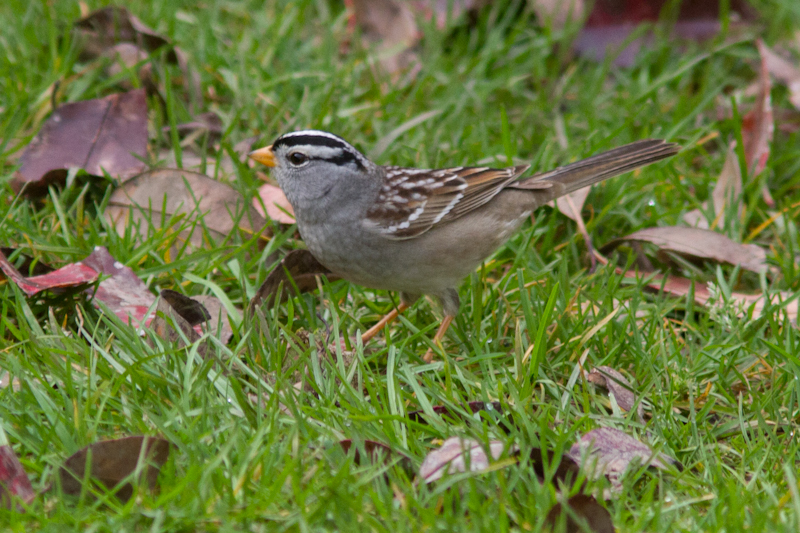
This migatory "Gambel's" White-crowned Sparrow can be differentiated from the local pugetensis subspecies, in part, by the bright white spots on its upper back, its thin black post-ocular stripe, and the very limited amount of dark coloring at the tip of its otherwise corn-yellow bill.

A molting and soon-to-be migrating Golden-crowned Sparrow stops in for a snack 

Our most abundant sparrow, the Dark-eyed Junco, is also on its way out.  Though not migratory in the true sense (in fact, a small number breed locally), most breed in the Cascade foothills.  A week ago, I could easily count a half dozen in the yard.  Now, I have two remaining individuals.  I imagine that they'll be gone by this time next week.


Local (non-migratory) movement is also big at this time of the year.  Many species of birds winter in the lowland urban areas and breed in the forests just outside of town.  On Eastern morning, we were blessed (no pun intended) by two of my favorites: Evening Grosbeaks (above) and Purple Finches.  Evening Grosbeaks have been flocking around town for most of the first half of the month.  At the beginning of the month, there was a flock of almost 30 split between our large Black Walnut and one of my neighbor's trees.  The following weekend, two females and a male came down to feed in the yard.  Just a few minutes later, a lone male Purple Finch began snacking at the same feeder.  April is a good time to see both species (Evening Grosbeaks tend to hang out here a little longer, into mid-May)

A male Purple Finch with a mouthfull of sunflower

Pine Siskins continue to hang around in flocks of 15-20.  Though they typically breed in the coniferous forests of the Cascades and surrounding foothills, some tend to hang around and breed locally (especially after an irruptive winter).

The large flocks of Pine Siskins (above) finally caught the eye of the local Accipiters (small hawks).  Both Sharp-shinned and Cooper's Hawks have been making the rounds recently.  Our local female Cooper's (below) has been especially aggressive, hunting in the yard multiple times over the past week.  She was even accommodating enough to give my rather loud two-year-old a good look...


In the midst of migratory madness, we would be remiss to omit a discussion of our year-round locals.  Anna's Hummers are still in shorter-than-usual supply due to the wet weather, but are still hanging around and resisting the migratory surge of the notoriously-aggressive Rufous Hummers.  Northern Flickers seem to have left for their woodland breeding grounds, but I'm still seeing a fair number of Downy Woodpeckers at the suet feeders.  Bushtits and Black-capped Chickadees - both local breeders - continue to represent in typical numbers.  American Goldfinches, greatly underrepresented this winter, have made something of a comeback.  And that's great, because the males look marvelous in their breeding plumage.

A female Downy Woodpecker stops in for some suet

This mostly-molted male American Goldfinch looks great in its breeding plumage.  I hope to see more of them this summer.

I love ending with a nice, bright American Goldfinch.  They're a beacon of better weather to come in a sea of overcast skies.  

It's supposed to be warm and sunny this weekend, with highs in the 70s.  And that means more migrants!  Black-throated Gray Warblers have made their way into town and will probably appear in the yard soon.  We may also see our first-of-the-season Nashville Warblers and Cassin's Vireos soon as well.  And we're about two weeks away from our first-of-the-season Black-headed Grosbeak.  What an exciting time.  Until then, good birding...