Saturday, September 22, 2012

Fall Planting

While technically still on hiatus, I thought that I'd share some photos of our recent fall planting...

Natives:


Deer Fern (Blechnum spicant)

"Longleaf" Oregon Grape (Mahonia nervosa)

Pacific Ninebark (Physocarpus capitatus)

Black Twinberry (Lonicera involucrata)

Red Elderberry (Sambucus racemosa)


Non-natives:

More accurately, these are species that are not native to the Willamette Valley of Western Oregon...

Saskatoon Serviceberry (Amelanchier alinfolia).

Golden Currant (Ribes aureum gracillimum).  The gracillimum variant is native to California.

Toyon (Heteromeles arbutifolia).  This the replacement plant for my Sitka mountain-ash, which succumbed to fire blight this summer.  As members of the rose family, Toyon are also susceptible to bacterial and fungal blight infections, but I will be treating it chemically during the dormant season.


As these get established over the winter, I hope to observe and photograph many interesting birds.  I'll be back with a bird-related post in a couple of weeks.

Friday, August 24, 2012

Going On Hiatus

After three unsuccessful attempts to get myself to finish a blog post over the past week, I've decided to take some time off.  My heart just isn't in it right now and I need some time to recharge my batteries.  (Plus, there isn't a heck of a lot going on in the yard.)


I'll leave you for now with this picture of one of two juvenile Robins that visited unexpectedly last weekend.  (Unlike out East, Robins are not common here in areas away from bodies of water in the summer.)  I hope to have pics for you soon.  See you in a month or so.

Saturday, August 4, 2012

Familiar Faces Return

This summer may have been the most uneventful on record.  Regular summer feeder birds such as American Goldfinches, Lesser Goldfinches, and House Finches were only sporadically present.  Thankfully, birds that did not nest locally are beginning to make their way back, some en route to their warmer wintering grounds.


One of the more interesting recent observations is the return of the Black-headed Grosbeaks.  A movement of them came through yesterday, and I've hosted both sexes of adult, as well as a first-year male, over the past 24 hours.  Black-headed typically arrive here in early May, breed near rivers or streams, and disperse in July.  Males (above) are typically on their way south by now (the one that I photographed this morning may be the last I see until next year).  Females and fledglings hang around for most of August and are usually completely gone by late September.


This hatch-year male Black-headed Grosbeak was the first post-breeding yard visitor of the season.

This male Red-breasted Nuthatch is one of two that's been visiting the feeders frequently since late July.

I'm also very happy to report that at least two Red-breasted Nuthatches have been frequenting the yard for a good week and a half now.  RB Nuthatches are very tame, acrobatic little guys that don't breed in the area and are even very spotty visitors in the winter.  For some reason, the second half of summer is the only time that they're reliable feeder visitors.

Lesser Goldfinches, who have been rather spotty visitors this summer, have made a big comeback this week.  A local pair has recently been visiting the nyjer feeder, along with its fledglings.  I presume that this is this pair's second brood of the season.

A male Lesser Goldfinch extracts nyjer seed...

...to feed its hungry offspring waiting above.

 A "horned" fledgling House Finch acquaints itself to sunflower seed.

Fledgling House Finches have been frequent visitors for the past month or so.  These young'uns are easily distinguished by their "horns," which are long downy feathers that they originally grew as nestlings.  After a little while, the "horns" fall out and they look like regular House Finches.

Juvenile Western Scrub-Jays have also been representing in large numbers.  I counted seven juveniles in the yard one day.  As much as I like them, it's nice that they've dispersed a little.  They're quite raucous, especially when a perceived threat (predator) is nearby.

This boisterous fledgling Western Scrub-Jay feeds on cracked corn.

Some other interesting sightings included an adult Northern Flicker foraging through our court with two juveniles.  Chestnut-backed Chickadees have been around semi-regularly for a good chunk of the summer.  I spotted my first post-breeding Rufous Hummingbird (a female) two weeks ago and have observed a juvenile male at the daylilies since then.  I've also been hearing Bewick's Wrens calling from the neighbor's yard recently.  Hopefully I'll be able to get photos of these latter two species sometime soon.

This adult male Northern Flicker was seen foraging terrestrially with two of its offspring.

Black-capped Chickadees have been one of the few regular visitors this summer.

This male American Goldfinch is likely in the early stages of nesting.  In a month and a half, we'll host up to 100 of them at the feeders.

Well, that's it for now.  In the next few weeks, I should be seeing migratory warblers and flycatchers moving through the area.  Wilson's Warbler, Black-throated Gray Warbler, Yellow Warbler, and Western Wood-pewee are the best bets for my neighborhood.  I hope to have photos to share.

Wednesday, July 18, 2012

Birdscaping

While the yard has become more birdy over the past week, there is still relatively little going on.  Thankfully, I've kept myself busy for the past month by "birdscaping" our yard.  As the name implies, birdscaping is landscaping for birds.  Feeders are nice and all, but not all birds eat seed, suet, or peanuts.  Providing natural food (especially berries) can help attract species such as waxwings, thrushes, thrashers, and some warblers and finches.


Part 1: Inherited Vegetation


When we purchased our home last summer, we inherited some bird-friendly trees and shrubs.  The most prominent is the mature Black Walnut (Juglans nigra) in our front yard (above).  In addition to providing shade to our home, this large tree produces walnuts each summer/fall that are eaten by both birds and mammals.  The neighborhood crows literally neglect our feeders in the late fall and focus their attention on the fallen walnuts.  (I've heard that other species, such as Flickers, are fans as well, though I've not witnessed it here.)  The local Douglas and Western Gray Squirrels also eschew the feeders (yay!) in the fall and focus their attention on the sticky green nuts.  Works for me.

Unfortunately, Black Walnuts present some major drawbacks.  The first is maintenance.  They grow very quickly and the walnuts are a pain in the ass to sweep/rake up.  The large specimen in the front yard requires professional trimming every other year, the walnuts crash down onto the roof in the middle of the night, and it seems that we are constantly cleaning up under the canopy of this tree in October and November.  Moreover, Black Walnuts secrete an aromatic quinone compound called juglone.  Juglone is toxic to several species of plants and trees (this helps the tree establish dominance), which of course restricts what one can plant around it.  (The grass under our tree tends to look rather sickly by November.)  Surprisingly, though, our rhododendrons and our magnolia tree - both of which are sensitive to juglone - seem to not be adversely affected by this tree and our neighbor's smaller specimen.  (Knock on wood!)


Our backyard features a cherry tree on our property, and an apple tree on the other side of the fence (above right and left, respectively).  I don't know which species of cherry this is (Black is my best guess), but can report that its berries are currently being eaten by Western Scrub-Jays and Chestnut-backed Chickadees.  I have yet to see it yet, but the neighbor's apple tree should be a good food source for Cedar Waxwings.  However, the unknown species of ivy that encases the trunk of this tree proved to be a good source of food for a migrating Swainson's Thrush earlier this year.

A migrating Swainson's Thrush enjoys berries from an unknown species of ivy.

Our backyard contains two California Wax Myrtle shrubs (Myrica californica).  These are the West Coast cousin of the better-known Southern Wax Myrtle (Myrica cerifera).  I've read that the berries attract several species of birds, including flickers, robins and finches, but have not noticed any of those snacking on the waxy berries.  However, many Yellow-rumped Warblers ate the berries on our shrubs last October and November, and they even appeared to prefer them over the suet that I put out.  (Incidentally, this is where the name for the "Myrtle" subspecies of Yellow-rumped Warbler originated.  They are the warblers that eat wax myrtle berries.)

One of our two California Wax-myrtle shrubs (Myrica californica)

A "Myrtle" Yellow-rumped Warbler enjoys the berries of its namesake.

We also have a couple clusters of daylilies around the yard.  They attract Anna's and Rufous Hummingbirds when they flower in July and August.  However, they also tend to get a bit overgrown.  The cluster above will likely be pulled out this fall and replaced with something more manageable like currant.


Part 2: Recent Plantings

So while all of what we inherited is nice, I thought that we could do much better.  I had previously purchased and plated a young Sitka Mountain-ash (Sorbus sitchensis) in the backyard of our previous home.  Despite an August transplant into the new yard, it not only survived but has grown a good 10" since April.  Sitka Mountain-ash is a large shrub that is native to the Pacific Northwest.  Its berries are enjoyed by thrushes, grosbeaks, and waxwings, among others.


Sitka Mountain-ash (Sorbus sitchensis)

American Mountain-ash (Sorbus americana)


While I prefer to plant native species, I recently decided that I wanted a small tree (something larger than the Sitka) that produces berries.  I decided on an American Mountain-ash (S. americana), which are native to Eastern Canada, New England, and the upper extreme of the Midwest.  Their berries support most of the same birds as its western cousin (moose also enjoy their leaves, though I doubt we'll be seeing those any time soon).

We inherited two large photonia shrubs that were both diseased, way overgrown, and shaded our lawn way too much.  I was initially reluctant to get rid of them because they provided good cover and perching space for the birds.  But they were so freaking ugly and I was getting sick of the far end of our yard resembling a swamp during the rainy months.  Many of their branches were also broken during our late-March snowstorm as well.  So we had them taken out back in early June.  Not only did their removal eliminate the aforementioned problems, but they also freed up more space for useful and ornamental plantings, and made the yard a lot brighter to boot.

A shot of our backyard during the Great Snowstorm of 2012.  The offending photinias are the large shrubs that are leaning halfway over.  The one on the left didn't fully recover.

June, 2012: The photinia-free yard looks a heck of a lot nicer.


Oregon Grape (Mahonia aquifolium)

Since our yard is relatively small, I only have room for so many large shrubs and small trees. So the rest of my birdscaping was limited to small shrubs and ground cover.  I purchased and planted several Oregon Grapes (Mahonia aquifolium) - two larger specimens (5+ years old) and six three-year transplants.  As their name implies, Oregon Grapes produce purple berries that have a (very) vague similarity to grapes.  Cedar Waxwings and other species enjoy these fruits.  One of the nice things about plants of the Mahonia genus is that they'll grow in shade and partial shade.  And when you have 40' x 40' walnut tree in your yard, a large percentage of your lot will be shaded for at least part of the day.

The blueish-purple grapes of M. aquifolium

There is a smaller version of the Oregon Grape that grows natively out here, often referred to as "Cascades Mahonia" (Mahonia nervosa).  I transplanted three of these from our previous residence.  Cascades Mahonia only grows to 1-2' in height and produces berries that are similar to its larger cousin.  Unlike M. aquifolium, M. nervosa does not do well in appreciable amounts of direct sunlight.  I discovered that more than 4 hours of direct sunlight per day will fry them.

Cascades Mahonia (M. nervosa)

M. nervosa in a location that received a little too much direct sunlight

Since we have a ton of open space around the perimeter of our yard, I figured that groundcover (whether it served as a food source or not) would be helpful to birds that like to stay hidden, such as towhees and sparrows.  M. nervosa serves this purpose to an extent, and I also added another native ground cover known as Salal (Gaultheria shallon).  Since one of the plants is already exhibiting new growth, I may add more this fall.  Salal spread via wandering roots, so I foresee a lot of pruning in my future.  They also produce berries that some species of birds enjoy.

Salal (Gaultheria shallon)

With room left over, I figured that a couple of rhododendrons would provide additional cover and perching space for my ground-dwelling birds.  They don't produce anything edible, but they're hardy, they're evergreen, and their flowers look really nice in the spring.

"Anna Rose Whitney" Rhododendron

"Clipinense" Rhododendron.  Because it was planted in an area that contains shallow tree roots and sprinkler system piping, I actually planted this one (mostly) above ground.  After digging down 2" and filling the hole with soil-forming compost, I surrounded the root ball with compost and then covered the entire thing in mulch.  This individual is also near the canopy of the neighbor's Black Walnut, so it should be interesting to see how this one does over the next year.

For the hummingbirds, we typically hang at least one potted fuchsia.  Like the daylilies, fuchsia is a good way to feed the hummers without having to clean out sugar-water feeders twice a week.

Hummingbirds love fuchsia.

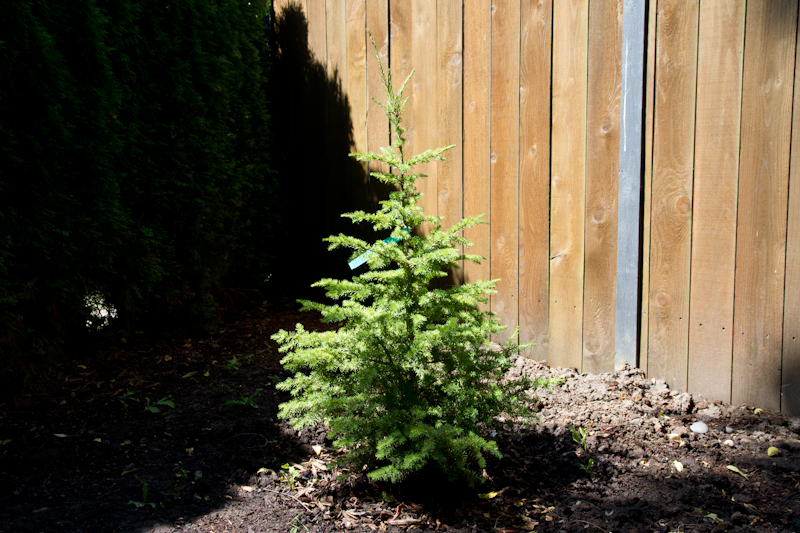
Last but certainly not least, I decided to plan an ornamental tree.  There is a corner just beyond the backyard fence that contained nothing and was literally screaming for a tree.  But it had to be something that (1) could grow in partial shade, (2) could survive living under a Black Walnut, and (3) would be thin enough at mature height to still fit in that corner.  I settled on Mountain Hemlock (Tsuga mertensiana).  These are the dominant species around the rim of Crater Lake and I've always loved their blueish-green needles and drooping "curlicue" crowns.  Mountain Hemlock are (broadly) native to this region, but they typically grow at 5000' and higher in the Cascades.  They are also notoriusly-slow growers, averaging less than an inch per year up to 15'.  For this reason, they are typically harvested from the mountains, rather than grown from seed in nurseries.  Thus, specimens of appreciable height can be difficult to find.  I got lucky and found a nursery in town with a few in the 3' range.  I'm sure that mine will not seed for several years and may just reach my height several years afterwards, but I'm happy with my purchase.  It's such a nice, picturesque little tree.

Mountain Hemlock (Tsuga mertensiana)

Well, that's about it for now.  I may plant some more this fall and will definitely provide an update on the status of these plantings next spring.

Tuesday, July 17, 2012

Snoozefest

It's been over a full month and a half since I've last posted and there are several reasons for this.  First, it was work, then it was vacation, and then it was a lot of in-state traveling to do landscape photography.  But there was one constant and overriding factor: no birds.  There isn't much point in blogging when there's nothing to blog about.  The last really interesting migrant sighting was on June 6th and relatively few exciting species habe been observed since.  So I bring you this boring post.  An unexciting - but necessary - chronicle of the part of the summer where no freaking birds are around.


Even in the midst of the massive snoozefest of June and early July, at least one unexpected individual is bound to pop up.  This male Dark-eyed Junco (above) was first observed on June 5th and hung around the neighborhood for the rest of the month.  The vast majority of juncos breed in the higher elevations (particularly the Cascades and surrounding foothills), but a decent number do have offspring here in the Valley.  I have hosted fledgling juncos at my previous residences here in town at least twice, so perhaps we'll see little junior juncos begging for food in early August.

A Western Wood-pewee hawks insects from high above on a late spring evening.

June 8th was an interesting day.  After getting home from work, I noticed a Willow Flycatcher hawking insects from my neighbor's maple tree.  Willows are the latest-arriving species of flycatchers here in the spring, with typical first arrival dates in mid-May.  I typically don't see them until early June.  Barely two hours later, another flycatcher (above) was hawking insects much higher up in the same maple tree.  Unlike the Willow, this one didn't come down to my magnolia tree for a good look.  After taking several photos against a gray sky as dusk approached and cranking up the exposure in Lightroom to highlight field marks, I finally identified this individual as a Western Wood-pewee (thanks to Alan Contreras for confirmation of the ID).  I don't see pewees in the yard very often (maybe once a year at most) so, despite the crappy photos, it was a nice find.


Flocks of Cedar Waxwings (above) roamed the neighborhood semi-regularly between mid-May and early June.  Again, the quality of my photos were somewhere between bad and terrible, but it was nice to see waxwings again.  They'll begin flocking again in the fall.

Late spring also bring juvenile starlings to the yard.  I'm fortunate to live in a place where I only have to deal with fledglings at this time of the year, plus an occasional roaming flock in the winter.  Unlike many urban/suburban-dwellers, they're not emptying my suet feeder every day.  Nonetheless, the preponderance of starling offspring left our deck covered in bird dookie, forcing me to take down the nearby suet basket and put up my caged suet feeder at the other end of the yard.


A juvenile starling hawgs the suet basket (and likely poops on my deck afterwards).

One of at least two juvenile Western Scrub-Jays that have visited the yard this month

Other more pleasant fledglings have also visited the yard over the past month and a half.  These include Western Scrub-Jays, Crows, House Finches, Lesser Goldfinches, Black-capped and Chestnut-backed Chickadees, and Bushtits.

Species that have made something of a comeback in the yard recently have included House Finches, Downy Woodpeckers, Bushtits, and Chestnut-backed Chickadees.  Red-breasted Nuthatches have also been calling from the conifers in the adjacent yards.

A House Finch enjoys sunflower seed on a warm summer day.

Our feeders have been a convenient source of food for hatch-year Lesser Goldfinches and their parents.

As the summer progresses, post-breeding dispersal will increase significantly.  In addition, early migrant movement will begin in mid-August, so it's possible that I may see a Wilson's or Black-throated Gray Warbler between now and then.  I hope to have more stories and better photos to share by then.

Thursday, May 31, 2012

Malheur NWR Trip

I don't normally post notes and photographs from the field in this blog.  (Perhaps I will create a dedicated page for that at a later date.)  But with migration movement being minimal here in Western Oregon, my yard is as dead as a doornail at this point.  So I figured why not share some photos from my recent trip to Malheur National Wildlife Refuge.  And, heck, it's pretty much impossible to not take a ton of photos of interesting birds at Malheur.

Malheur NWR is located in the high desert (elevation of over 4000 ft) of southeast Oregon, approximately 25 miles south of the town of Burns and roughly 100 miles north of the Nevada border.  The refuge is roughly t-shaped, with the northern end consisting of Malheur, Mud, and Harney Lakes, and a relatively narrow strip of land extending approximately 30 miles to the south, ending near the town of Frenchglen.  Much of this area consists of small lakes, ponds, and marshes.  (Being that this is desert region, I'd imagine that at least some of the marshland is seasonal.)  The abundance of water in such a dry area attracts ridiculous number of birds (over 320 species recorded), particularly during spring migration.  And the birds attract nerds such as myself.


The Yellow-headed Blackbird is one of the most common migrants at Malheur.

Not surprisingly, waterfowl and shorebirds are big here.  As I drove past Malheur Lake and the surrounding marsh area on my drive into the refuge on Sunday afternoon, American Avocet, American Coot, Black-necked Stilts, Wilson's Phalaropes, White-faced Ibis, Great Egret, Killdeer, Forster's and Caspian Terns, sandpipers, pelicans, and several species of duck were prominent.

American Avocet

Black-necked Stilt

White-faced Ibis

Wilson's Phalarope

Forster's Tern

Long-billed Curlew


Great Egret

Fledgling Killdeer

While traveling through some of the marshland south of Malheur Lake, this ostrich-looking individual was observed in an adjacent field...


It shortly revealed itself to be a Sandhill Crane...


An abundance of water means an abundance of insects.  And these insects attract vast numbers of insect-eating migrants, such as swallows and flycatchers.  Swallows were in such high abundance at times that they reminded me of the swarms of insects that I used to encounter on summer evenings in Indiana.  (Thankfully, no swallows were killed by my windshield.)  Tyrant flycatchers such as kingbirds, phoebes, pewees, and a few species of the Empidonax genus were also abundant (though not nearly as numerous as the swallows).

Barn Swallow

Tree Swallow

Bank Swallow.  Widespread, but in small, isolated populations that are not readily observed.

Western Wood-pewee

Eastern Kingbirds are not common in Oregon, but a small number do breed in the Eastern portion of the state.

I stayed with three other birders at the Malheur Field Station (MFS), which was also very flycatcher-happy.  The Western Kingbird below is a big fan of MFS.


Our mobile home was equipped with small platforms under the awnings, wich made for convenient nesting spots.  A pair of Say's Phoebes took advantage of the nesting spot next to our front door, and didn't seem to be bothered by our presence.

One Say's Phoebe hawks insects around the parking lot...

... while the other tends to nest duties.

Common Nighthawks can also be found in the area.  These birds aerially forage for insects and are most active at dusk and dawn.  During the day, they can often be found resting/napping on horizontal tree branches, fences, signs, etc.

 A Common Nighthawk rests on a fence.

Warblers enjoy insects as well, and it was difficult to not see Yellow Warblers on the refuge.  Several dozen of them could be seen in relatively small areas, and it was getting to the point where I could hear their songs in my sleep.  Some of the brushier habitats were also good for Yellow-breasted Chat.

A male Yellow Warbler sings atop a small tree at Benson Pond.

This Yellow-breasted Chat pops up for a second.

Malheur is also home to many small rodents (mice, voles, etc.), which attracts raptors and other predatory birds...

 
Great-horned Owls

Immature Red-tailed Hawk

Nestling Golden Eagle

Loggerhead Shrike

The raptor-heavy grassland habitats were also good for species such as Bobolink and Horned Lark.  We even spotted a late migrant Lewis's Woodpecker in this unexpected habitat.  Black-billed Magpies were abundant in areas closer to human habitation.

Bobolink

Black-billed Magpie

An uncooperative Lewis's Woodpecker keeps its distance from us.

One of Malheur's big attractions is the refuge's headquarters.  Located on the south end of Malheur Lake, its large oasis of trees act as a magnet for migrant passerines (perching birds).  Headquarters was jam-packed with Western Tanagers, Yellow-headed Blackbirds, Bullock's Orioles, Cedar Waxwings, Yellow Warblers, Warbling Vireos, among others.

Malheur NWR Headquarters

Western Tanager, male

Warbling Vireo

Bullock's Oriole (appears to be a second-year male)

Cedar Waxwing

California Quail, male

Lazuli Bunting, male

Hummingbirds were also abundant at the nectar feeders at Headquarters.  Male and female Black-chinned Hummingbirds, shown below, were omnipresent:


As the migratory movement of the "regular" Western birds begins to taper out in late May, vagrant Eastern species sometimes begin to appear.  We were fortunate enough to observe a few...

Baltimore Oriole, male

Black-and-white Warbler

Rose-breasted Grosbeak

We also observed a female Northern Parula.  I was not able to get a good photo of it, but Portland birder Diana Byrne obtained both a good photo and a video.

I'd like to thank Alan Contreras and Vjera and Eddie Thompson for letting me stay with them, as well as for their ID assistance, cooking, and camaraderie.  I'd also like to thank Alan for carting us around all day Monday, and for making frequent stops to allow me to obtain many of the photos shown above.